
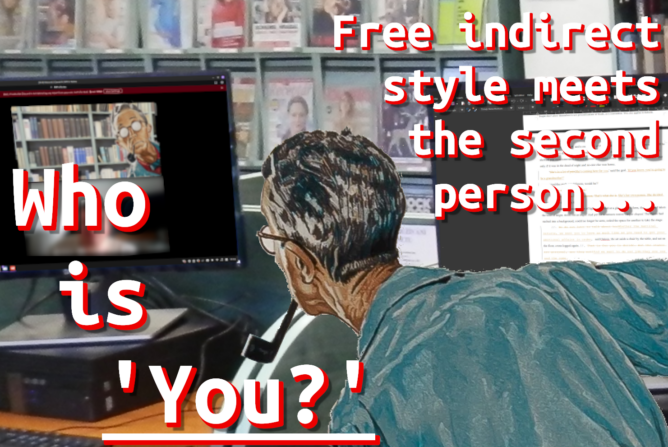
- TTLY…: Vintage posts.
Exhibit A: An email thread between me and Anne Boyer, one of my MFA supervisors2. I gave her an early draft of a short story that’s going to be part of my thesis, and she brought up this passage:
> Marjory gave a scoff, and a certain tilt of the head that showed disinterest. ‘I’m sure she’ll be pleased, whoever she is,’ she said. Actually, it was the sort of put-on disinterest that showed you were interested, but not because you cared. Some might call it “nosey fetishism.” But only if it was in the dead of night and no-one else was home.
And she asked:
Whose 'actually' is this? If it is important to pull away from her, how can you make these passages more distinct from the ones close in to her?
‘Who,’ said the master to the student, ‘is you?‘ My answer:
I didn't realise "actually" would signal a shift from a character to the narrator, but I understand why it happens. I like switching to the second person after someone speaks because it sounds more active and less voyeuristic.
You may well ask if I really did understand, if, as per the evidence, my prose did not achieve the effect I wanted. I thought I was drawing closer to Marjory, not pulling away from her. First drafts, especially mine, aren’t always so clear. Knowing what I want, but failing to execute it, must be a sign that the theory is down-pat while the praxis lags behind. Ironically, here I sit writing in the abstract, trying to chase that which might only be discovered in the concrete slog of editing and revision.
Before we move on: I write these posts for free, and as long as I have a stable income, free is how these posts will stay. I personally don’t like the idea of paywalling posts that you might find useful. Nevertheless, if you do enjoy what you read here, and leave this post with a greater understanding of the craft, please consider leaving a small tip on Ko-fi:
If any writer is the cause of me picking up this grammatical quirk, it’s probably Terry Pratchett. He seemed to know how to balance a character’s voice and narration, imparting judgements, but also showing what the character really thinks. Exhibit B:
Susan was sensible. It was, she knew, a major character flaw. It did not make YOU popular, or cheerful, and—this seemed to her to be the most unfair bit—it didn’t even make YOU right. But it did make YOU definite, and she was definite that what was happening around her was not, in any accepted sense, real.
Thief of Time, p. 281
Ever since Anne gave me that feedback, I’ve been on the hunt for this special ‘You’ in fiction. Since I’ve got an Exhibit A and B, let me add two more examples to make a quartet.
Exhibit C: An excerpt from Alvar Theo’s Benothinged, a queer horror novel that I read last month:
The monster took a step towards her. Irene screamed out with every fibre of her being.
Benothinged, p. 129
Mae straightened up and looked at her. At her, Irene was sure. [Irene is nonconsensually sharing her decaying body with a monster known as The Nothing]
‘Irene?’
There was a sensation like when YOU’RE half asleep and think YOU’RE falling, that peculiar quirk left over from evolution. The monster stumbled backwards, bowled over in pain.
Exhibit D: An excerpt from Francis Spufford’s Nonesuch – there’s even an ‘US’ in here:
The longer she saw nothing strange down the road, the harder it became to be sure that she had never seen anything at all. For what makes no sense is hard to hold on to. Recognition is what allows US to take hold of a perception, and to hold it fast in memory. Without recognition, a sight scrabbles for attachments in YOUR mind and finds nothing there to fit it…
Nonesuch, p. 48-9
So it’s not just a Pratchettism, as you can see. He did not invent this ‘You’ that we’re after. Other writers have caught it, and are showing it off to anyone who will read them.
Ursula K. Le Guin, in Steering the Craft, lays out the simplest, most straightforward model for identifying who ‘You’ is. Narrative voice and point-of-view belong to the viewpoint character, i.e., a character who is within the scene. “The only other person it [could] be,” she writes, “is the author.”
In a previous post on voice, I noted a similar answer from James Woods’ How Fiction Works:
https://brologue.net/2025/02/20/good-luck-my-ironys-behind-seven-implies/
As I previously understood him: once ‘You’ enters the picture, the author’s hand is exposed – it is not the character who is solely speaking anymore. His example is a passage from John Updike’s 2007 novel, Terrorist3:
Ahmad is eighteen. This is early April; again green sneaks, seed by seed into the drab city’s earthy crevices. […] He will not grow any taller, he thinks, in this life or the next. IF THERE IS A NEXT, AN INNER DEVIL MURMURS. What evidence beyond the Prophet’s blazing and divinely inspired words proves that there is a next? Where would it be hidden? Who would forever stoke Hell’s boilers? […]
At the point the ‘inner devil murmurs,’ we’ve supposedly left Ahmad’s thoughts altogether, and let the author in. I understood where Wood was going, but I still thought it was entirely reasonable to believe that an eighteen year-old could ask themselves these questions about the afterlife in a more philosophical voice.
I couldn’t be arsed at the time to dig deeper into why Wood chose Terrorist as an example, and I forgot to follow up. Wood reviewed Terrorist for The New Republic nearly 20 years ago:
https://newrepublic.com/article/64175/jihad-and-the-novel
He does, in fact, address my point about Ahmad’s voice in the article: ‘A “pained stateliness” that is redolent, I suppose, of many hours of Koranic study and deep, intolerant cogitation.’ There’s a key critique of Updike in here that will help us pin down this ‘You,’ but it involves a certain narrative technique that I don’t want to talk about just yet.
Back to Pratchett, in the meantime:
Susan was sensible. It was, she knew, a major character flaw. It did not make YOU popular…
Terry Pratchett wrote these words, invented Susan Sto Helit, her belief in being sensible, and her belief that this is a character flaw.4 But take the ‘You’s out:
Susan was sensible. It was, she knew, a major character flaw. It did not make HER popular, or cheerful, and—this seemed to her to be the most unfair bit—it didn’t even make HER right. But it did make HER definite, and she was definite that what was happening around her was not, in any accepted sense, real.
One single pronoun shift, and all of a sudden, we are no longer WITH Susan, or looking THROUGH Susan’s eyes. We’re watching Susan behind a sheet of Plexiglass. We’ve dropped out of Discworld and ended up… somewhere else. He wrote ‘You,’ and his editor left those ‘You’s in there. Surely they must be there for a reason?
Exhibit E – Nonesuch, again, with our protagonist, Iris Hawkins, out looking for a man named Geoff:
That was where the thing had seen her, where it had got the scent of her and followed her somehow two months later to Cornellis & Blome. Somehow, somehow, she had picked it up from her night with Geoff. Like a burr stuck to her skirt. Or a nasty rash. Yes: some people, if YOU made the mistake of sleeping with them, left YOU with a rash, or regrets. This one apparently left YOU with a monster.
Nonesuch, p. 69
‘Left YOU with a rash… with a monster?’ Who does Spufford mean – me? Go, my Exhibit F – C. S. Lewis, help me out, here:
Something was crawling. Worse still, something was coming out. Edmund or Lucy or YOU would have recognised it at once, but Eustace had read none of the right books.
Voyage of the Dawn Treader, p. 45
Hmm… these don’t feel like the same ‘You’ to me. C. S. Lewis’ narrator is explicitly and directly addressing You, The Reader. The ‘You’ in Spufford’s passages is the ‘You’ I wanted – I am content that these are all Iris’ thoughts – but it is not the ‘You’ that Anne found.
Literature – the medium, all of it, from the canonized so-called classics to Captain Underpants and the AO3 fanfiction you’re burning through – excels at building up, and then immersing you in, someone else’s interior reality. Sometimes, we do watch characters performing actions from the sidelines. Other times, we’re behind them in the corner of the ring, passing along water, and towels, and we loosen their shoulders; other times, still, we are with them, blow by blow. What we’re really doing when hunting for this special ‘You’ is asking how close the writer has placed us within the experience.
John Gardner (the American one) described this in The Art of Fiction as ‘psychic distancing.’ Are we in a stream of consciousness, where the narration takes on the thoughts of the character? Maybe we’re a fly on the wall—words, gestures, and blows exchanged, but we’re not fully invited into their frames of mind.
The psychic distance between reader and character is seldom static, and one way we can close in on a character is to use free indirect style. This is a technique that Wood brings up in How Fiction Works, but for a primer, I’m going to refer to this video by Cameron Montague Taylor:
https://www.tiktok.com/@ceemtaylor/video/7579309142502935863
TL;DW You let the narrative voice take on the character’s voice and mannerisms. I’ve described this before as ‘pretending to let the character write the story for a moment.’ And now for Exhibits G and H, two short excerpts from my WIP:
 'Sir Holdem?' they said.
 The Sir stared. Dead, orthodox eye contact. What'd Roy been so worried about? Anyways, like Araminta always said, YOU never found anything about a person through the eyes. YOU had to wait for the tongue, and listen.
 B2-1 risked giving Holdem the finger. Two fingers. No reaction whatsoever.
 Straightening up to face the horizon, as though a giant, invisible hand posed him at the joints like a mannequin, the old man still did not acknowledge their existence. The staring contest had never really begun.
You may not know who Roy is – he is not in this scene, for clarity’s sake – but the narrative voice inhabits B2-1, and they’re asking why this creepy old man terrifies them. You may not know Araminta – also not in this scene – but the old man reminds B2-1 of her advice: watch what someone says and then does. Then we move away from B2-1, back to the indirect style, to focus on how Holdem moves. (I may change this, I may not – still drafting this one!)
‘Then it’s not a metaphor. Fine.’ But metaphor, she [Gladys] knew, was the complex answer, the academic answer, the anthropological answer. YOU could press it down with the sum total of recorded human experience and then cut to find the gem of provenance. Just because it was an answer the Crown liked, that didn’t mean it wasn’t rational. No other human being had ever transferred their consciousness, or soul, or whatever, to another living thing. Monarchs never pretended to work miracles alone.
Like Araminta always said, YOU never found anything--
YOU never--
YOU could press it down--
YOU.
And there it is. I can manage it. The gen-u-wyne, boner fee-day ‘You.’ When YOU see it, YOU’ll be able to do it, too. Matter of fact, I’m doing it right now, as I’m typing this sentence in Obsidian. It’s the anthropological answer:
Philosophers tend to define human consciousness in terms of self-awareness; neuroscientists, on the other hand, tell us we spend the overwhelming majority of our time effectively on autopilot, working out habitual forms of behaviour without any sort of conscious reflection. [..] What neuroscientists (and it must be said, most contemporary philosophers) almost never notice, however, is that the great exception to this is when we’re talking to someone else. In conversation, we can hold thoughts and reflect on problems sometimes for hours on end… if we’re trying to figure out something by ourselves, we imagine arguing with or explaining it to someone else. Human thought is inherently dialogic.
David Graeber and David Wengrow, The Dawn of Everything
It’s the autodialogical ‘You.’ The intrapersonal ‘You.’ The ‘You’ that I found more active than just reporting what someone thinks. Susan, Iris, B2-1 and Gladys are all using it. When there is nobody to talk to, and we must work through our thoughts, because we will soon need to persuade other real people of a point or experience that we have, we invent a ‘You’ to figure out what we might say. Thus, when we close in on psychic distance in third-person limited, the intrapersonal ‘You’ reveals itself. There’s no reason why fictional characters can’t or shouldn’t express their inner thoughts with the intrapersonal ‘You.’
I think Exhibit A’s ‘You’ is confusing exactly as Anne wrote: there wasn’t a clear enough signpost for the reader to enter Marjory’s thoughts. It comes straight after a line of dialogue, which is an action that externalises thought, but not one where we are always in the same POV afterwards. For all anyone knows, that ‘actually’ may belong to that older, pre-modern form of third-person narration, where the author literally chimes in to pause the story to address You, The Reader.
The fix? Well, Marjory knows what she’s doing. She has a lifetime’s experience in expressing disinterest in things she is actually very interested about. Making this explicit to the reader wouldn’t sully anything in the subtext, so I’ll keep it simple (stupid). I can make it clear to the reader what she knows, then immediately close the distance with ‘YOU’:
Actually, AS SHE KNEW, it was the sort of put-on disinterest that showed you were interested, but not because you cared.
I had Wood entirely backwards: the intrapersonal ‘You’ is not an opening for the author, but for the character, just as with free indirect style. We were always on the same page! These techniques, he argues, were something that a veteran, Pulitzer Prize-winning novelist could not grasp:
He will begin a paragraph in his character’s voice, and then, apparently [lose] any capacity for the necessary ventriloquism […] The effect is that whenever Ahmad opens his mouth he sounds like a septuagenarian Indian aristocrat. […] [he] has no personality, no quiddity as an eighteen-year-old American, so he is Updike’s serf, ready for whatever the writer chooses to do with him. […] Updike’s style does not enable his dramatic functioning as a novelist, it actually nullifies it. When Ahmad speaks, he sounds like V.S. Naipaul; but when Ahmad thinks, he sounds like John Updike.
https://newrepublic.com/article/64175/jihad-and-the-novel
But YOU and I can. We’ve put a name to it, so it can’t slip by us anymore. The next time you’re editing a passage that sounds like a bunch of boring reportage, try rewriting it in free indirect style, and see if the intrapersonal ‘You’ can’t liven things up.
- Background: Knihovnaberoun, CC-BY-SA 4.0 (modified) ↩︎
- But not just my MFA supervisor – she’s also the author of The Undying which won the 2020 Pulitzer Prize for nonfiction:
https://uk.bookshop.org/p/books/the-undying-a-meditation-on-modern-illness-anne-boyer/3395214 ↩︎ - Completely apropos of nothing, the Kill the Computer podcast recently did an episode on 9/11 fan-fiction with Aysha U. Farah:
https://www.killthecomputer.com/
https://s389.podbean.com/pb/48585e5b8889f9a8c4ac50f03ca77508/6a30a03d/data1/fs11/14547508/uploads/fanficayshafinal.mp3?pbss=f58fa7df-9ed0-5856-b459-bd4fee8d5218
It’s an interesting retrospective to me because, despite living through the entire 2000s, I wasn’t aware of just how prevalent 9/11 was in culture writ large. It’s pretty clear that Terrorist is also a part of this response:
https://bsky.app/profile/gwenckatz.bsky.social/post/3mo6piqexzk23
https://www.typebarmagazine.com/nostalgia-ends-here-the-2000s-sucked-actually/
And it is eerie that, despite COVID being only six years ago, it hasn’t had nearly the same impact as 9/11 did. Powerful people are eager to tell us that we should just forget it. I don’t believe them. If you know of any books in particular that set during COVID, or a COVID-like pandemic, do let me know. ↩︎ - Not necessarily in this order – Thief of Time isn’t the first Discworld book where Susan is the protagonist. But I think you get what I mean. ↩︎
TTLY… (permalink)
- [14 Jun ’24] Liminal Time https://brologue.net/2024/06/14/the-liminal-is-the-means-by-which-all-is-revealed/

