

Or, “On Worldbuilding Discourse.”
- TTLY…: Old posts.
EDIT (10/6/26): I’ve made a lengthy edit near the end of this post, just to clarify some things. I’m going to let it settle for a while and return at a later date – say, a few months from now.
HOLD IT! Yes, it is a rather blithe title, isn’t it? A couple of months ago, I made a post all about some worldbuilding ideas that I introduced to a group of St. Andrews undergrads:
https://brologue.net/2026/03/20/worldbuilding-workshop/
As a fantasy writer, looking to write ‘imprint’ fantasy, I’d be hard-pressed not to take some interest in worldbuilding. I want to write the real thing. I want diamonds on my necklace – not the zirconium shards you get in magical realism, where no-one seems to believe that the dragon really is a dragon. Give me incluing, give me lore, give me magic (hard and soft), give me humans and every sapient creature under the sun figuring out how to live together.
What I don’t want to find is your director’s commentary. I find it boring in the same way that describing dreams is boring. You’ve researched and thought through some interesting, yet gnarly problems – that, I relate to. In some small way, your understanding of our world has grown, and so have you as a person. But even if I might learn something from you, those problems may not be immediately applicable to me.
I don’t mean to sound incurious. Really, you (singular) are not the problem, and I’m sorry if you’ve rage-read this post, looking for an argument. It’s absolutely true that, once you introduce magical elements to your world, you have to think through the second and third-order consequences. Terry Pratchett put it best, IMO:
You are allowed to make pigs fly, but you must take into account the depredations on the local birdlife and the need for people in heavily overflown areas to carry stout umbrellas at all times.
Notes from a Successful Fantasy Author: Keep it Real
Likewise, Jo Walton and Ada Palmer in Trace Elements:
It’s often very clear when the author didn’t have a full image in mind, because the elements of the world will not be consistent in a way that (A) could add up, and (B) takes second-order consequences into account. [..] the very frustrating moment when you realize that rookie wizards can cast “multiply bread” and “summon cow” trivially after a month’s practice, but there’s still somehow a famine and it makes no sense.
Genre Pacing and Protocols, or What Is Genre?
It’s the public discourse that I find fault in. There’s something about worldbuilding advice online that makes me feel like I’m looking through a kaleidoscope at the wrong end. For now, I’ll focus on YouTube, and move to other popular fora later.
A few points I want to bring up, before we go any further.
- What follows is largely conjecture. I’m writing down things that I have observed, and felt. This post is a seed that I’m planting to come back and water later on. If it spurs you to share it, or make a response, please do keep this context in mind. These thoughts aren’t all finished yet;
- I will give mention to people whose examples I think are worth following. As for those who I will not mention by name: I don’t think ill of them, at all;
- I actively despise being treated as an authority on anything. Though I will take a persuasive tone on this blog, my impact on the web (or lack thereof) suggests that I’m not big enough to move discourse by saying ‘I don’t like X.’ If I somehow become Britain’s next biggest fantasy author, nothing would mortify me more than to hear my word valued over others because of book sales, or guest appearances, or whatever.
- Did you know: I think through and then write these long posts for FREE? Yeah. No paywalls or nothing – free is how it ought to stay. This blog doesn’t cost much to keep online, and if you think my voice is worth hearing in this great big sci-fi/fantasy conversation that we’re all having, please consider giving me a small tip:
What sorts of titles get clicks on YouTube? In the time since my last real YouTube upload (January 2022), vidsmiths can now assign multiple, alternating titles for the same video. At first, my gut feeling was that it’s much like advertising or self-help: vidsmiths want to persuade you of a problem you didn’t realise you had. But this is much too cynical, I think. Good thing that gut instincts can be (and often are) wrong.
A less cynical (and surprisingly simple) answer can be found in the title of Summoning Salt’s latest video (a channel entirely unrelated to fiction writing, I know):
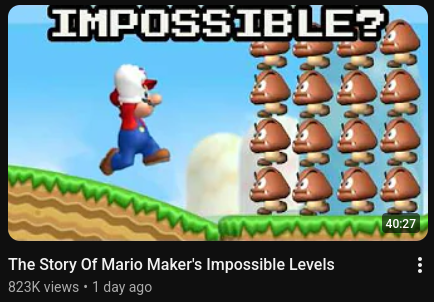
You see it, right? The STORY.
The story – from Rumpelstiltskin to War and Peace – is one of the basic tools invented by the human mind, for the purpose of gaining understanding.
Ursula K. Le Guin, “Prophets and Mirrors: Science Fiction as a Way of Seeing,” The Living Light 7, no. 3 (Fall 1970)
YouTubers are storytellers as much as you and I, and if one wants their story to divulge understanding, one has to give one’s audience a hook – a title to stoke curiosity, fear, or desire:
https://vidiq.com/blog/post/write-click-worthy-youtube-titles
(As with any website that claims to dispense publicity advice, take the big picture with a grain of salt, but the idea that our curiosity is piqued by the use of certain words isn’t all bullshit. Are our choice of words not one component of rhetoric?)
Folks want to build worlds, but don’t know how, and they won’t find many answers when writers are put on the spot. Not entirely unlike self-help, what is being sought after is the vidsmith’s hyperspecific nugget of wisdom that shall shine through the closed door of the mind, once said vidsmith is done battering down said door.
But it’s never just the one nugget, is it? No, I’m not about to say that the YouTube algorithm hijacks your dopamine to keep you addicted for hours. If you’ve found yourself down a rabbit hole of worldbuilding videos, you’ve not only discovered a genuine interest in worldbuilding, but begun to develop a mental catalog of advice. Not every nugget will shine on you, but some will, and those nuggets you will take to heart. That’s quite different to an addiction.
It’s never just the one nugget. Your desire for worldbuilding knowledge shines bright, and the more nuggets you pick up, it shines all the brighter… and the less you notice the shadows that you cast.
Using myself, as an example: when I’ve fallen down worldbuilding rabbitholes, I’ve felt immense unease from vidsmiths telling me how I should be doing this, or why I should avoid that, or the secret other thing that I need to figure out, or else my world supposedly won’t work. Whether it is their intention or not, I’m being asked to fetishise worldbuilding – oooooh, time to hyperfixate on THIS random doohickey for a week! – and I dunno about you, but the vibes are uncomfy. It’s a dialogue that I am not an equal participant in; a story that I don’t think is as true as told.
A couple of weeks ago, I stumbled across a worldbuilding video that approached fantasy mapmaking from a logistics angle. The vidsmith even offered a worksheet, that I might apply what they were trying to communicate. Great, I thought, Logistics are still important in fantasy. Should be a fun exercise. I’ve been trying to get into city builder games lately, because I’m not very good with maps, and, what the hell, it’ll be fun to learn urban planning, something I know little about.
Just a few wee problems with the video. Firstly, I had to join their Discord to download the worksheet. I’m not exactly a fan of obscuring free content on Discord, and every time I see someone at this, they are always trying to build their own fandom. Weird vibes, but creators need eyeballs where they can get ’em. For a video that billed itself as describing a problem that often ‘breaks’ fantasy maps… well, there wasn’t much fantasy in it. Magic wasn’t mentioned a single time.
Then I scrolled to the comment section, as you do, and found a fair few critiques of the logistical model presented in the video. Good critiques, for YouTube commenters – not your average one-liners. They offered up some sources that I was already aware of, such as Brett Devereaux’s Collection of Unmitigated Pedantry:
Which is more than can be said for the vidsmith! Their tone was quite authoritative on the matter, their metaphors lucid (‘Feudalism is just a supply chain with a crown,’ grain storage being like a battery for local communities), so it surprised me when the description lacked those keyest of details…
THE REFERENCES.
Now, I’m not some pedant who needs to fact-check each and every claim, but this is a video uploaded to a post-Plagiarism-and-You(Tube) platform:
https://www.youtube.com/watch?v=yDp3cB5fHXQ
I can’t take the word of a vidsmith who is largely anonymous and doesn’t cite their references. If you are making a name for yourself by teaching others how to build better worlds, including citations for further reading is the bare minimum:
https://brologue.net/2026/02/26/factfinding-workshop/#simple-facks
This is not a trade where we can afford to be knowledge-hoarding weirdos. If Devereaux’s blog was read in the making of this video, it should be cited.
And what about that Discord, eh? I’ll tell you: It is a hodgepodge of self-assigned authors, dungeon masters, and… ‘worldbuilders.’ Like, as a category. Like, for people who worldbuild in their spare time? I guess? Whatever; it is a genAI-friendly server, and there is an entire channel dedicated to posting slop. One user posted a bunch of images for their worldbuilding, arguing they had to use AI to produce these images, not just because commissions are spenny, but because the contents of those images were things that ‘didn’t exist yet.’
They used genAI. Technology that cannot think of the future, let alone think. Technology that can only aggregate data from the past. They used genAI to create references for objects that “don’t exist yet.” Give me strength and get a grip.
I keep lurking, out of curiosity, because I don’t co-exist in AI-friendly spaces, and I figure this server’s a good a place as any to see what goes on. So far, I have been treated to such titillating discourse as: ‘Chapter Titles: Should We Have Them?’ I am NOT making this shit up:
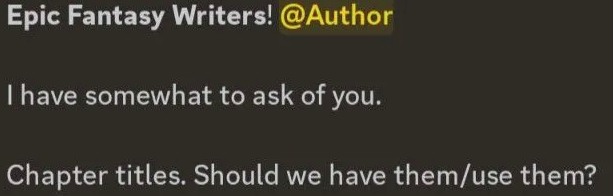
AdjectiveVerb#6790: Hmm… I think it depends on what time period you’re writing in, but that’s just a gut feeling, and gut feelings can be wrong.
LørdØfTheM1ndP4lace#1111: nøt sure 1f true but here’s what grøk s41d
This is like the author equivalent of the XY problem:
What the fuck are you actually trying to ask here? Who is getting tripped up on whether chapters should have titles or not? You can’t seriously tell me this is the hot topic of the month for worldbuilders. This question is such a timewaster as to be anti-craft. The worst part? Other users entertained this patter for a solid hour and a half.
Among the most unhinged things I’ve seen in this server was a user who posted a large city map that they claimed to have been planning for years. In Microsoft Paint. On Windows. Fucking. VISTA. Why? As a feat of urban planning, I daresay it’s commendable. But as a worldbuilding process? It’s not missing the forest for the trees – it’s more than that. Kublai Khan1 has laboured over this forest, leaf by fucking leaf! And for what? Fine enough, if it’s for their own self-satisfaction, but if you caught me at building up this MIND EMPIRE, you’d have to shoot me. I’d never write a single word of story.
So, what’s the problem here? This is art we’re talking about – does art not rely on collaboration? Shouldn’t I be more sympathetic towards my fellow writers? Worldbuilding fora can help us discover an interest in it, yes. They also document people who have fallen into a positive feedback loop that fetishises worldbuilding above all else:
Jen Williams, in her essay Building a World and Getting Away With It, describes this as the ‘worldbuilding is king’ approach. As a hypothetical, she imagines a world placed atop a giant sky beetle, and begins to play around with the details: how these people might live, what religions there are, etc.. All good, all fine, all making pigs fly and accounting for depredations on the local birdlife.
The problem comes when you take this to heart as a hard rule – that you must have all the details down when you start writing:
This is a trap. It’s all too easy to get lost down these roads, gathering more and more detail to yourself like that creature in the rubbish tip in Labyrinth who insists to Sarah that all of these things are important, all of these things are treasure. [..] How much do we really care where the priest buys the cloth that she uses to sew the glittering cloak she wears over her robes? Is it vital that we understand precisely how many silver bits make a gold bob?
As collected in “Writing the Magic: Essays on Crafting Fantasy Fiction”
If you plan to parody the time-honoured tradition of asking a wealthy plute the price of everyday essentials, sure. But if your characters aren’t preoccupied with how much something costs, and what that means, then that group of tabs on money in Tudor England is merely interesting. If it’s not absolutely essential to the matter at hand, narratively speaking, I don’t need to know.
Then there’s Ursula K. Le Guin, who wrote a bit about how she built Earthsea, all the way back in 1973:
There are words, like rushwash tea, for which I can offer no explanation. They simply drink rushwash tea there; that’s what it’s called, like Lapsang souchong or Lipton’s here. [..] If you press me, I will explain that it comes from the rushwash bush, which grows wild and cultivated everywhere south of Enlad, and bears a small round leaf which when dried and steeped yields a pleasant brownish tea. I did not know this before I wrote the foregoing sentence. Or did I know it, and simply never thought about it? What’s in a name? A lot, that’s what.
Dreams Must Explain Themselves
On the other hand… What do I see in worldbuilding fora? Very little. That is to say, when someone asks a very specific question, then that question is all I know of their world. Their world, for all intents and purposes, is a black box:
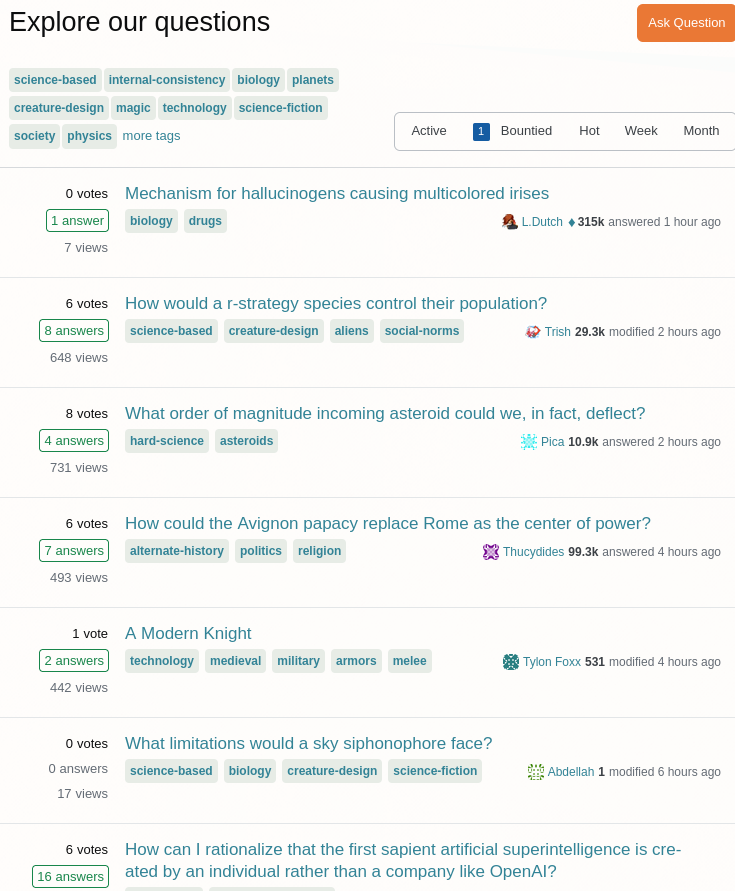
These questions are literally not for me. For all I know, ‘Abdellah’ may already have a first draft and is just trying to shoot the shit – ‘what if siphonophore, but in sky?’ Cool! The Worldbuilding Stack Exchange may just be Thucydides’ regular, who has several books under their belt. Whether any of these people have got stories, let alone a consistent world, who am I to know?
Those worldbuilding nuggets may glitter, but how many of them are pure gold? What is deemed good advice for the tabletop writer may not be so good for the prose writer; the former may need to know how many silver bits make a gold bob, for their party, while I do not. Magic must be constrained by statistics, so that the party might negotiate on what to do; I disclose the rules of magic so that an attentive reader might be rewarded later. A DM might be asked anything about a given scenario; me, too, but if it ain’t on the page, why should I answer? You want lore; I’ve got to leave you wanting more. We can’t have it both ways.
EDIT (10/6/26): For the avoidance of doubt (or, perhaps, the creation or more, who can say)… what I mean by other people’s worlds being a ‘black box’ is that I cannot possibly know what a person’s priorities are. The questions are all I see:
https://en.wikipedia.org/wiki/Black_box
I found one (1!) worldbuilding server whose vibes and patter I disliked. I’ve made mention to YouTube, r/worldbuilding, and the Worldbuilding Stack Exchange, but I don’t believe I set out to tar the entire online community with the same brush.
Worldbuilding fora are all giant tents, full of creators who don’t all have the same priorities; people who are not playing the game of prose writing (metaphorically speaking), because worldbuilding is not a servant of, and solely confined to, prose. That is fine. That’s not an issue to me. That is a pancake to this waffler’s conversation. If you aren’t a prose writer, then I’m not going to tell you how to play your game. Likewise, this post is not intended for you. Believe me, I do know something of the satisfaction of simulating worlds – that’s why I’m trying to play more city builders and the like.
No worldbuilding forum can satisfy all of the people all of the time:
https://dl.acm.org/doi/epdf/10.1145/3512908
I won’t doubt that there are great pockets of discourse to be found in these large communities, but when I’ve been lurking in the past, I felt I wasn’t missing much.
Hobbyists of all stripes co-exist with the fact that there are amateur2 prose writers out there who take their craft a touch more serious, but get well stuck in the weeds, and end up writing a wiki that grows out of hand, and they don’t know where to start. To the latter, I say: try writing flash fiction against the clock – say, 25 minutes. Put two characters in a situation. Once you’re done, I think you’ll have a motor with enough torque to wheel some of The Lore™ in.
I also love projects like the SCP Foundation, or Scarfolk. If they are what you’re trying to emulate, then crack on:
But to the former, to the hobbyists: You do you. I can’t tell you how to play your game.
At first, I thought all this was quite clear – in hindsight, I understand why some people might misinterpret the above paragraphs as a show of ignorance and arrogance. That’s not what I intended. I am reacting to one (1!) server, based on incomplete information (I do not have a holistic view of any Discord server that I am in), but what information exists is enough to be an example of scope creep. As some responses to my post have indicated, it is an example that writers resonate with.
I’ve said it below, and I’ll say it again: I may be working towards an MFA, but I do not think of myself as being above any writer. And I am the very last person who will tell you that you need an MFA to write prose; that if you’re not writing to get published, then what’s the point.
My advice for worldbuilding is unglamourous, but to repeat it: if you must do research before you write, set a deadline that you will honour:
https://brologue.net/2026/03/20/worldbuilding-workshop/#a-fickle-dragon-of-ideas
The only way out of Worldbuilder’s Disease is through. Take this excellent series of posts by Cameron Montague Taylor, in which she recommends writing character-focused flash fiction against the clock:
https://www.cameronmontaguetaylor.com/tag/worldbuilders-disease
I tried something similar with my worldbuilding workshop, adapting an exercise from Tiffani Angus and Val Nolan’s Spec Fic for Newbies series:
https://www.lunapresspublishing.com/product-page/spec-fic-for-newbies
The first draft will not be written by tinkering in the margins. You’re going to lay down some of the mangiest, most abysmally dogshit doggerel of all time, word by word, and it will neither reflect that beautiful three-dimensional world that you can rotate in your head (unless you have aphantasia like me), nor the map in the front matter that you think will guide me. Your draft will look and feel a bit like this:

But it will objectively be more of a story than… this:
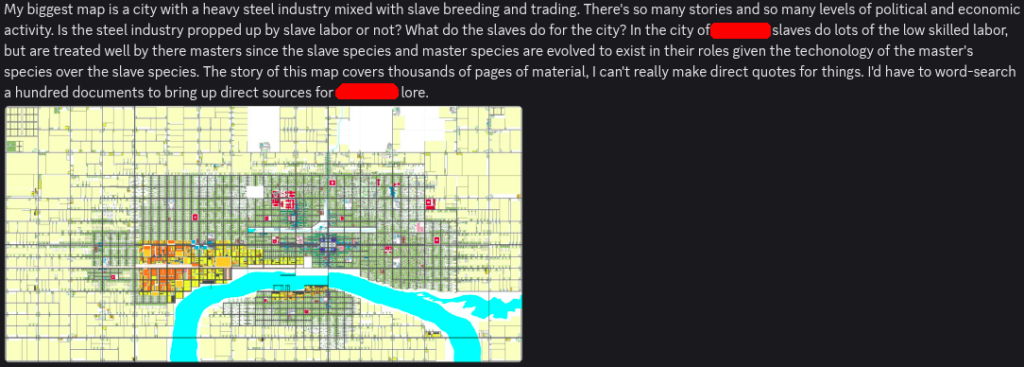
I’ll believe there’s ‘so many stories’ here when they are written and published – and if they turn out to be the hottest shit since Tolkien, I will deep-fry and then eat my own hands. For now, this city lies on a vista boundless and bare, perennially out of reach.
I exaggerate your flash fiction as ‘abysmally dogshit doggerel’ not because I’m working towards an MFA and think I know better than you, but because I know how it feels. It’s like coming to accept how your voice sounds in a recording. Creation is painful. Worldbuilding fora, in my opinion, are not communities that you need to be a part of to learn worldbuilding. They may be large and full of people who wish to study the craft as an equal, but close-knit bonds are hard to come by. If you find videos or posts that take an authoritative tone, posts that are doing numbers, and you don’t know how much skin OP has in the game, question it. If they give no references, don’t give them your time.
Now, having talked the talk… how do I walk the walk?
On my workstation is a text file for a story I plan to write after my thesis. It’s a short fantasy story (OK, 17,000 words) that will focus on a very specific set of Wikipedia pages. This text document currently contains a grab-bag of elements that I largely curated on the 18th January. I added a few things after that date, up to the 20th February, but since then, I’ve only opened it once or twice to skim the contents (like right now, as I’m writing this). At some point, Future Me will sit down of an evening, and – if he is resourceful with his time – figure out how my records join up. Who knows who? What are the rules of this object? How might X lead to Y? And so on. If we must dichotomise ourselves into plotters and pantsers, planners and discoverers, architects and gardeners, I will happily go to bat for the pantsers/discoverers/gardeners. I do not plan my worlds in advance, much.
This text file does not contain every last drop of minutiae that I need to know. A not-insignificant minority of things I’ve collected will make it to the first draft, but no further. Without a doubt, Future Me may write a scenario that warrants a little further research, and it’s a fool’s errand to predict what he will need to know. I accept that he will curse me out.
The cream of the worldbuilding crop on YouTube are those vidsmiths who make you feel like you’re part of a dialogue. Their videos tend to introduce you to something new, explore it in video essay format, but they leave you feeling free as to how you might work this new information into your WIP (if it’s even workable at all). Two stellar examples off the top of my head – Overly Sarcastic Productions, and Tale Foundry:
https://www.youtube.com/@OverlySarcasticProductions/videos
https://www.youtube.com/@TheTaleFoundry
They never tell you how to tell stories, but always fill their videos with arguments and concepts that’ll spur you to re-evaluate how you think about not just your own craft, but the craft of other storytellers. I recently revisited Tale Foundry’s excellent video on monsters in the Backrooms, prior to seeing the film:
https://www.youtube.com/watch?v=PfrtN2LlgSI
The Backrooms are supposed to be monster and labyrinth, but I understand why the film needs monsters. In the original copypasta (and in the YouTube series), it’s implied that if you noclip into the Backrooms, you’re in the belly of the beast already; you’re fucked. That doesn’t quite work when you need to keep the plot of a film moving. Kane Parsons’ retelling also establishes that, if you know which walls to run at, you can leave. Thus the need for a monster to re-establish a sense of eerieness by lurking behind distant blind corners. I think that if the film had no monsters, I would not be talking about a psychological thriller right now, but an avant-garde film. Mind you, I’d be down to watch two hours of people fumbling through nonsensical, half-remembered corridors – not everyone is.
Meanwhile, in OSP’s recent video on ‘Dream Apocalypses,’ there is a brilliant sidenote ten minutes in on individual reality, shared reality, and dreams:
https://www.youtube.com/watch?v=snfflY-ztHk&t=628s
I didn’t really think about reality being constructed through continuity, causality, consequences and corroboration before this video. It’s been a useful framework for thinking about some of my characters, and the magic they have no control over.
These creators also have Discords – hell, Tale Foundry just wrapped up a crowdfunding campaign to expand the ‘lore’ of Talebot – but never have they hard-pressed me into supporting them beyond a YouTube subscription. I am allowed to engage with these channels and their creators on my own terms, and I think that their ethos reflects a mutual respect. I, too, am thinking about branching out to YouTube again, and when I start creating videos on writing fiction, this is how I want to make ’em.
On that note, this is all I’ve got to say on worldbuilding, for now. Stay curious, try not to overdo it, and if I gave you pause for thought and made a difference to your day, consider making a small tip:
It’s my Ko-fi jar. I gotta rattle it when I get to the end of a post, whether you’re here or not…
- Italo Calvino’s Invisible Cities is a fictional dialogue on worldbuilding between Marco Polo and Kublai Khan. TL;DR: Kublai Khan keeps falling for Marco Polo’s ragebait, and eventually, the latter reveals that all the cities he mentioned travelling to were just Venice…
…OK. Now for the REAL TL;DR. During the Part 3 Prologue, the Khan, an empire builder, grows skeptical of Polo’s cities being real. The Khan builds a city in his head, based on Polo’s descriptions, and challenges him. The explorer laughs. He was just beginning to tell of this city, for an important reason: the set of imaginable cities cannot contain those cities whose components do not share ‘a connecting thread, an inner rule, a perspective, a discourse.’ That is:
“You take delight not in a city’s seven or seventy wonders, but in the answer it gives to a question of yours.”
“Or the question it asks you, forcing you to answer, like Thebes through the mouth of the Sphinx.”
In the Part 4 Prologue, the Khan broods over his empire. Stagnant, it has been crumbling all around him for years. Despite this, there are still times where he looks out beyond Xanadu, and imagines new, splendid structures. He cannot but crave more details, more lore, more beauty. Marco Polo is his opposite: he builds his cities from exceptions, and finds the norms within. Octavia, the spider-web city, flutters atop a great chasm, between two mountains. He does not explain how this precarious city continues to function. We just have to believe him.
My point is, the Kublai Khan sort of worldbuilder may be driven to discover fictional places, but they cannot satisfy themselves until every question is answered, and every depth plumbed. ↩︎ - ‘A lover of something,’ ‘a person attached to a particular pursuit:’
https://en.wiktionary.org/wiki/amateur ↩︎
TTLY… (permalink)
- [9 Jun] I Don’t Like Backlogs, Actually https://brologue.net/2025/06/09/backslog/
