
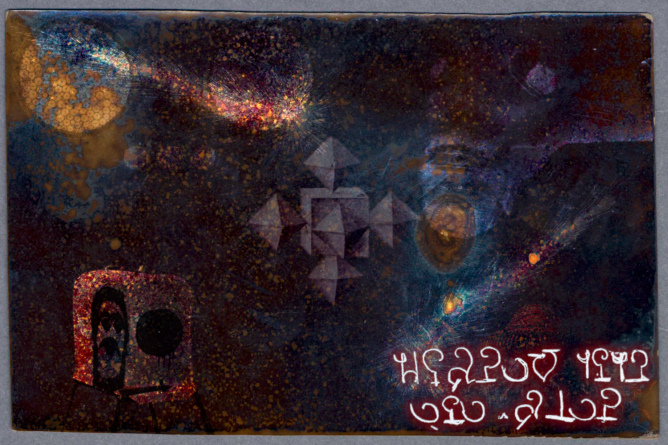
The sixth and final installment of “The…” Fantasy, As Yet Untitled:
- 1. A Cry for the Eerie – Mark Fisher: a palate cleanser for all those Freudian texts you’ve been forced to read;
- 2. Welcome to the New Weird – But not before brief detours to Lovecraft and Lucian;
- 2.1 Fantasy’s Weird Emulsifiers – Oil and water can, in fact, mix;
- 3. ☜︎♏︎❒︎♓︎♏︎📪︎ ☜︎♏︎❒︎♓︎●︎⍓︎ ✋︎■︎⧫︎♏︎❒︎♏︎⬧︎⧫︎♓︎■︎♑︎ 📫︎ ✋︎ ♐︎□︎❒︎♍︎♏︎♎︎ ⍓︎□︎◆︎ ⧫︎□︎ ●︎□︎□︎🙵 ◆︎◻︎ ♋︎ 🕈︎♓︎■︎♑︎♎︎♓︎■︎♑︎⬧︎ ⧫︎❒︎♋︎■︎⬧︎●︎♋︎⧫︎□︎❒︎🖴︎
- 3.1 ♋︎☠︎⧫︎✋︎❍︎☜︎❍︎☜︎⬧︎📫︎ 🗏︎🖲︎♊︎🗏︎🖲︎🕯︎📄︎📄︎📬︎🖮︎✂︎☠︎ 🖰︎📄︎♊︎🗏︎🖮︎🕯︎📂︎📄︎📬︎📁︎✂︎☜︎🖴︎
- 3.2 ✌︎︎■︎︎☠︎︎♓︎︎☟︎︎♓︎︎☹︎︎♋︎︎❄︎︎♓︎︎⚐︎︎■︎︎ 📫︎ 📂︎📁︎♊︎📁︎🗏︎′🗐︎🗏︎″💧︎ 📂︎🗄︎📄︎♊︎📂︎🖰︎′🗐︎⌛︎″🕈︎🖴︎
- 4. “But It’s Still Magic–“ – Is it? Is it, though?
- 5. Brief Reflections – TL;DR, I think I came up short but I ain’t quitting;
- TTLY… – Old posts.
1. A Cry for the Eerie (permalink)
The ontology of magic in a fantasy world often undermines both the weird and the eerie. It’s much harder to have “something where there should be nothing, nothing where there should be something” because magic is the ultimate source of unexplained agency. How much room there is for the eerie depends on how your magic works.
For example: You could not write Daphne du Maurier’s The Birds as a fantasy story, not in the same way. The characters in that story exhaust every avenue of explanation and still come up short; introduce magic, and now, an agent can be identified: an angered witch, an ancient curse, the prophecy, a spell gone wrong, or a god. Unless you can think of a reason for the eerie that is not subsumed by magic, that still escapes the logic of your world, you will strain credulity.
By ‘the weird’ and ‘the eerie’ I am of course referring to Mark Fisher’s collection of essays of the same name:
For Fisher, the weird is an external intrusion – phenomena that impinges our natural, ordinary reality from outside of it. Outside is where its ontological basis begins, and ends. Where Freud’s uncanny can be explained, for Fisher, weird happenings always have some je ne sais quoi that is beyond description.
As for the eerie: we could say it’s an epistemological absence. The eerie can be conceptualised and described, somewhat, but no matter how many circles we run around it, there is always a something where there should be nothing, or vice versa. Large Language Models are a real world example of our times. For all of human history, art has been a conversation that requires an agent who intends something – the creator – and an agent who is willing to engage this conversation – the reader/viewer. No-one has ever had a conversation with a chatbot, because chatbots lack intention. If there is a ghost in the machine, writing mediocre prose, it is because you have imagined a something where there is nothing.
We’re going to try to define the weird and the eerie as they pertain to fantasy. If our worldbuilding introduces new, mundane forms of agency, to things that would be considered eerie in realist prose, where in our worlds do we find the real, bonafide sources of eerieness?
And to tell you the truth: I don’t know for sure. I’ve done a lot of reading on this, and reflected upon the many conversations I’ve had with friends and peers who are weird-inclined, but I am still uncertain if it is enough. Buddhists point their fingers at the Moon, tell us that the Moon is enlightenment, and that we should not confuse it for the pointing finger. I should like to bring you further to the Moon – failing that, a little past the atmosphere1. What follows is not a didactic digital demonstration, but a curious, open-ended prod. If finding the weird and eerie in fantasy is a worthwhile excursion for your craft, I’d like to know how you think they might be found.
For now, we turn to some writers of the New Weird…
2. Welcome to the New Weird (permalink)
If the weird, as Mark Fisher suggests, is an intrusion on the established world from something truly outside of it, then where exactly is the outside? Take H. P. Lovecraft, for example. To him, ‘outside’ was outer space, and the deep sea – depths that, in his time, had scarcely been plumbed. Of course, storytellers across the globe have imagined creatures and societies living on the Moon and under the sea, well before Lovecraft, but in a way that brings these locations ‘inside.’ One of my students told me about Lucian of Samosata, the 2nd-century Roman author of A True Story (sometimes translated as True History). It is the earliest text, some scholars have argued, that could be categorised as sci-fi/fantasy (if we pretend to ignore the anachronism of genre2):
https://www.jstor.org/stable/1348255?origin=crossref
https://www.jstor.org/stable/4239038
https://en.wikipedia.org/wiki/A_True_Story#Science_fiction
It is a satire of Homer, among other writers, and to greater outlandish heights does Lucian go – to the Moon, and to Venus, where first contact is made with alien races. All befitting of science fiction (and perhaps fantasy, if you substitute ‘alien’ for ‘human-adjacent’). It is bizarre, but Fisher’s weird it is not. Peopling the cosmos with humanoids and architecture familiarises the strange. Our modern understanding of the weird celebrates the strangeness as it is, and intentionally maintains a divide between the human and non-human.
Of the China Miéville books I’ve read, Embassytown comes closest to showing how fantasy writers can keep it weird. (It’s technically sci-fi, and I am sure Perdido Street Station would serve as a better example, but I haven’t read it yet!) The novel is set in the titular outpost on the planet Arieka, on the remotest edge of space. Humans living in Embassytown (and anthropomorphic ‘exots’) have learned to coexist with the indigenous Ariekei (aka “Hosts”). These fellas get a lot of visual descriptions, but still end up being tricky for the mind to imagine (at least if you’re me), but artists have tried:
https://outtherebooks.wordpress.com/2014/02/27/what-do-the-hosts-ariekei-from-embassytown-look-like/
Their appearance is uncanny, sure. What makes them truly weird is Language. Spoken with two mouths, Language is communication and cognition; entirely objective, with some caveats. Any creature who lacks the anatomy needed to speak Language are perceived as unintelligent (humans liaise with Ariekei through Ambassadors, genetically-modified identical twins). More importantly, the Ariekei struggle to understand symbolism and abstraction. Similes can only exist in Language if the thing they compare themselves to is literally true. For instance: some Embassytowners have been asked to become figures of speech by repeating a ritual, like swimming with fishes once a week. If they don’t keep up the task, then the simile falls out of Language.
Ariekei understand Language only when it is spoken with intention. And because they perceive intention objectively, it is nearly impossible to lie in Language. You can replicate Language with a computer, but there is no mind in the machine to talk to, so the Ariekei don’t understand a word.
Just as humans have transformed nearly every inch of land on Earth, the Ariekei are the universe’s only experts in “biorigging.” Embassytown’s Ambassadors teach the Ariekei how to lie, and in exchange, they get access to organic architecture, power sources, weapons, breathing apparatus, etc..
They have technology, the Ariekei. They have agriculture. They have culture, in their Festivals of Lies. But no ordinary human mind can meet theirs, and we can’t even begin to read their intentions from body language, because that’s a human abstraction. Imagine though we might, that feeling of not-belonging – the weird – permeates most of the novel. It is decidedly uneerie, however, because (without spoiling too much of the novel’s middle parts) – we recognise their agency, and we know when said agency is deprived.
So, emphasising the unhuman aspects of intelligent lifeforms may be one way to charge fantasy with the weird. Suppose we extracted Language from Embassytown, and gave it to a sessile race of mushroom folk? In a nod to Miéville, let’s call them the Altshiitake. We know, for instance, that some species of mushroom hook up to plants in the local area to exchange nutrients and (potentially) communicate:
https://www.bbc.co.uk/news/science-environment-48257315
I’ve seen videos where people attach electrodes to a fungus’ fruiting body, and translate the changes in electrical resistance to synth notes:
https://www.youtube.com/watch?v=EYPhCFmtyX4
Some research has been done as to whether mushrooms have ‘language’ or not – as is the case with a lot of fringe science that gets hyped (and criti-hyped) by science journalism, the real answer is, “we don’t know enough yet:”
I’m skeptical. In fantasy, however, we can fill the gaps. We can say, yes, Altshiitake folk both communicate and perceive the world through their mycelium, and humans have figured out that their communications can be intercepted and repeated using certain materials. How the altshiitake work the underground to their needs, we don’t know – but dwarves won’t go near them.
2.1 Fantasy’s Weird Emulsifiers (permalink)
We’re close, I think. All the bits and pieces needed to make some odd little guys are there – save one. See, the trouble with weird fiction crossing over with fantasy is that the former aims to estrange the reader from language, and from the world – to be reading in a “constant state of shock,” as Miéville describes in this interview:
https://www.youtube.com/watch?v=GaaFun09At0&t=941s
There’s something very exciting about the creation of monsters that have no antecedents within a folklore tradition.
Whereas I think the archetypal fantasy wants to explicitly familiarise you with strange new worlds while building on the traditions that came before. We are, as per Lucian, being asked to accept this strange new world as a true story.
It seems that fantasy and the weird are destined to be oil and water. Sure – and if I keep writing in the abstract like this, you might walk away, convinced. But oil and water mix in the real world all the time. Ever heard of emulsifiers?
In the third volume of their Spec Fic For Newbies series, Tiffani Angus and Val Nolan show us some emulsifiers, while addressing the dilemma I’ve just described:
https://www.lunapresspublishing.com/product-page/bundle-spec-fic-for-newbies-1-and-2
[The weird] yokes together two contradictory impulses: disclosing as little as possible while simultaneously overwhelming you with descriptions of repulsive objects and places, a “teeming which exceeds our capacity to represent it” [quoting Fisher].
(Lovecraft’s characters, for instance, had a peculiar habit of claiming the cosmic horrors were ‘indescribable,’ before going on to describe their appearances in great detail…)
Something they recommend we do is to experiment with “contradictory descriptions.” I know a wizard from a previous workshop who’d know all about those sorts of things3…
EXERCISE (20 mins): You’re a wizard. Your cool and powerful enby date has left you a puzzle to decipher: a sphere-shaped cube. You both know that magic is an ally of geometry – Euclidean, and non-Euclidean – and you’ve watched your colleagues make some pretty strange objects before: spheres that turn inside out, irrational cubes, even a working tesseract; but nothing like this.
You can figure out what this thing does later. What I want to know is:
- What qualities does the sphere-cube have that appeals to our senses?
- What qualities are hidden or withdrawn from us?
- How does it confound our expectations?
If you had that ‘wrong’ feeling in your head, making up something that can/cannot exist, but must, that’s weirdness at work. Did you catch yourself trying to correct these obvious impossibilities with logic? The weird cannot be so cleanly categorised. Since we’re revisiting our wizard character, you might have already made the link between weirdness and incluing. In Worldbuilding, we established incluing as a technique for making puzzles out of exposition:
https://brologue.net/2026/03/20/worldbuilding-workshop/#lets-plot-a-clue-interclue
https://web.archive.org/web/20111119145140/http:/papersky.livejournal.com/324603.html
Weirdness can be inclued, although the result is not so much a puzzle being solved as it is inverted exposure therapy. Typically, writers start by establishing a banal baseline for reality. Lovecraft, in a few of his stories, opened with immersive paragraphs of rural New England (The Colour out of Space, The Dunwich Horror). We follow his young city-slicker academics, who end up seeking knowledge beyond their ken. At some point, along comes an elder member of the township to spin a fearsome yarn, at which point the first drop of weird has been diffused. The happenings keep coming, the drop turns to drip, turns to drizzle. As the butterfly’s wings cause the tornado, the academic’s observations precipitate the weird’s insurgence.
3. ☜︎♏︎❒︎♓︎♏︎📪︎ ☜︎♏︎❒︎♓︎●︎⍓︎ ✋︎■︎⧫︎♏︎❒︎♏︎⬧︎⧫︎♓︎■︎♑︎ (◻︎☜︎❒︎💣︎♋︎☹︎♓︎☠︎🙵)
So, what about the eerie?
The eerie, write Angus and Nolan, “draws power from the unknown: why is this curious object or structure here?” It is “evoked by repetitions and judicious use of aural description.” Eerieness can exist in fantasy when the reader is unaware of the world, and the systems therein; it really can be as simple as repeating an abstract symbol and offering little or no explanation.
3.1 ♋︎☠︎⧫︎✋︎❍︎☜︎❍︎☜︎⬧︎ (◻︎☜︎❒︎💣︎♋︎☹︎♓︎☠︎🙵)
In qntm’s There Is No Antimemetics Division, the Unknown Organisation secures, contains, and protects4 all manner of strange entities (‘Unknowns’). The antimemes are by far the strangest: information-based ‘self-keeping secrets;’ photo-negative ideas that survive by preventing their own repetition; though they may be extensively documented by UO, they are persistently forgotten when not being observed. Every time a member of the Antimemetics Division works with an antimeme is the first time. Over and over. Mnestics (psychoactive drugs only available to UO employees) help maintain awareness of antimemes while at work, but they don’t last.
Antimemes are far, far weirder than I suggest. Can they be eerie? Early on in the story, one character encounters an enormous Unknown that overshadows the UO Wyleigh building; they’ve never seen it before. U-9429 is a 91x91x147m black basalt monolith, with smooth, uniform rectangular extrusions across its surface (12.5x5cm), as well as entrances and stairwells. It looks human-made, but that’s impossible: the basalt doesn’t come from the area, and it weighs some 3 million tonnes, making it so massive that moving it in one piece would defy the laws of physics. UO holds a wealth of knowledge of many alien/eldritch entities – it wasn’t built by aliens, either.
After a page or two of speculation, one of the characters gives the answer: It’s an antimemetic structure, so it was created by an antimemetic culture. You’d think that’d ruin the eerieness, but the main conceit of antimemes is that they are the ultimate ‘something’ where there should be nothing. There might be an antimeme in your room as you’re reading this, right now, and you will never know, because we are physically and mentally incapable of experiencing whatever stimulus their non-existence puts into the world. Some antimemes will isolate you, feed on your memories, and than erase the memory of you from everyone else’s minds. It may look like someone at your work, who just barely doesn’t fit in – but by the time you notice this, it’s already too late.
There is much the Organisation doesn’t know about U-9429, and the entities who built it. For all anyone knows, they could still be out there. To quote Fisher, again:
The problem here is not why the people who created these structures disappeared – there is no mystery here – but the nature of what disappeared. What kinds of being created these structures? How were they similar to us, and how were they different? What kind of symbolic order did these beings belong to, and what role did the monuments they constructed play in it?
3.2 ✌︎■︎☠︎♓︎☟︎♓︎☹︎♋︎❄︎♓︎⚐︎■︎ (◻︎☜︎❒︎💣︎♋︎☹︎♓︎☠︎🙵)
Another eerie example: the first chapter of Annihilation, the first book of Jeff VanderMeer’s Southern Reach quartet.
Four scientists – a biologist, a surveyor, an anthropologist, and a psychologist (hereafter capitalised) – are sent out explore the mysterious ‘Area X,’ a coastal area kept hidden by the secret agency known as Southern Reach. This is where the weird things are. The Biologist (our POV character) observes how the wildlife always seems to watch her and her crewmates with a particular intent. A boar charges the team, but veers at the last second as if pulled by an invisible force. During nights, they all keep hearing the shrill cry of an unidentified beast, and express an eagerness to track it down at some point. Their days, on the other hand, are focused on exploring a bunker in the woods, sixty feet across. Besides the entry and stairwell, the rooms are completely devoid of any intentional trace of life. Moreover, the structure, despite being plain to see, was not recorded on any previous maps.
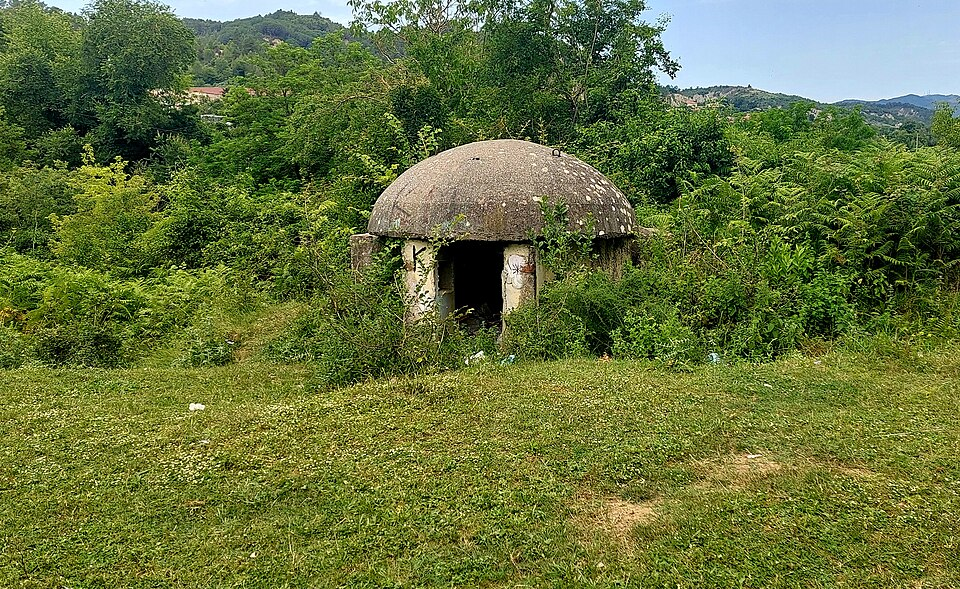
The crew soon descend into the bunker’s liminal chambers, and find a fungus-like colony extruded from a wall. It glows. It is arranged to spell out words that the Biologist is able to understand and parse aloud, despite the fact that they are ‘written’ in a non-human script (so argues the Anthropologist). Again, there’s the suggestion of an agency – the only creatures known to organise symbolic information like this are humans – that oughtn’t be, but is.
The intention in the air, the compressed biomes, the shrill cry, the abandoned bunker, the fungus, and so much more – Annihilation’s first chapter is a diorama of all things eerie. VanderMeer creates the eerie by incluing: for every concrete fact given by the crew, there are as many things they don’t understand. I, as the reader, trust that the things VanderMeer will leave unexplained will be rendered all the more alluring – but not frustrating. If I feel a presence in absence, or vice versa5, it is because VanderMeer intentionally put it there – not a failure to disclose, but a decision not to. None of his characters straight up say, ‘oh my god the wildlife is sentient,‘ but I sure as hell have my hunches:
[The boar]’s features were somehow contorted, as if the beast was dealing with an extreme of inner torment. Nothing about its muzzle or broad, long face looked at all extraordinary, and yet I had the the startling impression of some presence in the way its gaze seemed turned inward and its head willfully pulled to the left as if there were an invisible bridle.
It’s one hell of a clue. Perhaps this is the last time I hear about the boar – I don’t know, yet – but this presence the Biologist notes will certainly return, and with it, the (figurative) ghost of the boar.
4. “But It’s Still Magic–” (permalink)
With all this in mind, let’s turn back to fantasy. Who’s saying that magic must explain it all?
Magic is the ultimate source of unexplained agency.
Oh. I said that. But considering the examples we’ve gone over, despite not being explicitly fantasy, something about my argument no longer satisfies. In fact, it sounds an awful lot like a familiar fantasy tenet with different words: ‘If magic can make anything happen, then nothing is interesting.’ There’s a rhyme.
You could not write Daphne du Maurier The Birds as a fantasy story, not in the same way.
Magic does not have to be the ultimate source of unexplained agency if you don’t want it to be.
Let’s give this hypothetical retelling some proper thought. Here’s what I’m thinking: We tell the reader early on that a practised witch can probe the woodlands with her mind, and ride atop the consciousness of any small animal. She needs a place to sit quietly and empty her mind, to tap into the universal magic that drives all living things. An expert witch, with decades of practice, can attempt to transfer her consciousness to a colony organism – ants, bees, wasps, and termites. In legend (as well as in theory, but the legends came first), the most powerful witches could do this across multiple, separate animals, but not without going completely mad. As per any story where a hard magic6 system is explained, readers will glom on to the rules, expecting their speculation to pay off later – that’s part of the contract you make with them. Crosswise, with eerie tales: the reader keeps in mind the unexplained, and tries to rationalise with the characters, but the eerie will not leave until we, the writer, explain.
To let the eerie in, we should also give our reader hints that there are some phenomena that look like the output of a magic system, but are not. Otherwise, revealing that the magic system is not the cause of the birds’ attack will have all the anticlimax of, ‘oh, it was all a dream.’ One by one, the ‘structures of explanation’ that characters rely on to make sense of the world will be thwarted: the birds must be attacking because of the weather; because of a Russian poisoning; because of a blasted heath; because of a witches’ spell. A bird horde like this cannot naturally occur, so it must be the result of a human spell, and that human must still be living in the local area – yet there are no traces of anyone who would possess such magical prowess.
Suppose, then, that an upstart, twenty-something witch decides to investigate, determined to prove that this really is just a case of a spell gone rogue. What would she find? What would she not? What is a hive mind without a mind? Hell, would she even come back alive?
https://tvtropes.org/pmwiki/pmwiki.php/Main/HiveMind
A good a time as any to revisit and revise Angus and Nolan’s questions:
- What qualities does this eerie event have that appeals to our knowledge of the magic system (i.e., what exists that might provide agency?)
- What qualities are hidden or withdrawn from us (what do we not know)?
- How does it confound our expectations?
For the type of reader who consumes didactic worldbuilding content on YouTube, the eerie is going to be a subversion of that Sandersonian contract – if it looks like a magic problem, and sparkles like a magic problem, then it must be solved by magic. Losing their interest is not a tragedy – there will be people who enjoy reading about magic systems, discovered and refined through academic rigeur, that are nevertheless thwarted by agents that will forever be beyond magic’s ken.
5. Brief Reflections (permalink)
This post took a lot longer than I’d anticipated. My in-person workshops ended weeks ago with admittedly little fanfare. Attendence was patchy in the last few weeks, but in fairness, I did block out my workshops late into the second semester – as I learned, undergrads take Easter break more seriously than I do7.
This teaching business is a lot harder than it looks. Certainly, it’s the hardest thing I’ve ever done.
One of the struggles as a dyspraxic writer is having to constantly second guess if all the pieces I’ve put down connect up into a greater whole. Does the effort I put in justify the output, and vice versa?
https://en.wikipedia.org/wiki/Effort_justification
I mean, I think I have to give myself credit for doing all this research, and writing a good 25,000+ words8 that I didn’t need to write, on top of a 40,000-word thesis that’s due in four months’ time. I think it all makes sense. Maybe. At the same time… will these essays of mine be helpful? Will they be useful maps for walking through the gnarly, nebulous woods of the craft? Or does it all amount to peppy, woolly affirmations: “Hit these bullseyes and your dominoes will fall like a house of cards?”
Doubt whelms me – there is, I think, much room for revision in the future, but for now, I haven’t enough time. I did what I could.
On the other hand, it wasn’t a total fucking shambles. The written word doesn’t convey this very well – I did remember to break up my class with writing prompts, and activities, and those were well-received. I now understand what twenty minutes feels like in a ninety-minute class (which is to say, I had enough material to run each class for a full two hours, but I didn’t want to disturb the schedule that I’d established early on). I’m not going to walk back from teaching just because I’ve come up short at the hurdle.
There’s this irrational fear I’ve had stewing for nearly a year and a half – that my reading and writing and communication skills aren’t as sharp, and now that I’m 25, it’s all downhill – I am doomed to grow incurious of the world:
https://brologue.net/2025/01/06/its-the-attention-economy-stupid/
The days are getting shorter, and so too is my output. It’s not even procrastination. Some days I’ll sit down to read a text or article that isn’t too long, blink, and find that hours have passed. I woke up before 9am today and am bewildered to read my laptop’s clock and find the time at 2:13pm. I blink again, and now it’s 2:20pm. Time shouldn’t work like that.
Friends tell me it’s way too early in life to worry about cognitive decline, and I believe them, but reason is not a strong enough weedkiller for anxiety. This blog being a public ledger of what I think, I look back and realise that I was gripping the coattails of the tech bloggers and creators who inspired me to start. Now (at least since September 2024),my posts are more focused on writing – even if I have thought to myself, This is it, this is what I’m doing now, that does not mean my adjustment started and stopped at that thought.
2:50pm. There’s much I’ve yet to learn, and I must learn these things by moving forwards. I know I’ve been here before. I used to be a prolific Smash Ultimate competitor, up until around 2022. I never made PR, but I was good enough to occasionally take a game off of some of Scotland’s best players. My mindset, however, was dogshit. Even though I reviewed my VODs, practiced combos in the lab, and theorycrafted outside of the game, I was convinced that no matter how much effort I put in, it would never be enough, and I would never improve. I had no idea what else I could be doing. I believed this even when people tried to tell me that everyone active in the Ultimate scene was marginally improving with me.
Real life doesn’t have training montages. No-one goes from zero to hero overnight, and yet, like any sport, people love to come up with personal mythologies for exceptional players. Perhaps what I wanted more than to be a skilled player was to be the player who became skilled out of nowhere.
3:07pm.
We’ll see if I still hold these doubts after I get published. There’s every chance that I will. But I’ve a better head on me now than in the Smash days – the one thing I’m not going to do is quit.
- ‘Towards a glittering star’ is the nicer, if less accurate metaphor. ↩︎
- Suffice to say: Lucian didn’t exactly have an agent liasing with a publisher to get his story put on a printing press:
https://en.wikipedia.org/wiki/Latin_literature ↩︎ - The prompt that follows is a borrowing from one of Angus and Nolan’s exercises. ↩︎
- Y’know… like the SCP Foundation, which this story was originally a part of, before having its serial numbers filed off for its Del Rey publication. ↩︎
- I’m pretty sure the Psychologist is a (fictional) real human being, but her HR smile and role as crew hypontist instill a fearsome ick in me. No, lady, you are a friendly interface of some private equity colony organism, and I can feel it. ↩︎
- For the sake of brevity – no, I’m not going to explain the rules beyond this. I will take my D in Magic Systems Engineering and see you after class. ↩︎
- Shout-out to the one student who was there for every class (you know who you are). ↩︎
- 27,496 by my count, but this is inflated a tad with hyperlinks, front matter, and bottom page matter, so round to the nearest thousand. ↩︎
TTLY… (permalink)
- [May 4] Some Ramblings on Form in Fiction https://brologue.net/2025/05/04/form-is-emptiness/
- [May 12] Terry Pratchett’s ‘A Blink of the Screen’ https://brologue.net/2025/05/12/blink-at-screen/
- [May 25] Jorge Luis Borges’ ‘Library of Babel’ and Other Stories https://brologue.net/2025/05/25/thems-good-storytellin/
