
- 1. Cleaving Plot and Story: Plot and story as fine distinctions;
- 2. Beginnings: On threshold moments;
- 2.1 Orc City: Scrutinising the hottest orcshitpost of Summer 2025;
- 3. Middles:
- 4. Endings: Before You Land:
- 4.1 Endings: After the Crash:
- 4.2 Endings: Deus Ex Chartis:
- TTLY…: Old posts.
1. Cleaving Plot and Story (permalink)
‘Ethics’ and ‘morals’ are said to be fine distinctions of each other. Ethics: intelligible principles of right and wrong – rational, and codified in text. Morals: right and wrong as a felt sense. Though teachers and language pedants may lecture you on what is the ‘correct’ word to use, language changes, and meanings intermix, and what some call ethics, others will cry morals.
In the books I listed at the end of my first entry in “The…”, each writer provides their own understanding of plot, and story. I think these are also fine distinctions of each other. “The plot thickens,” people say – but isn’t it our characters’ stories that are about to change?
My understanding of plot and story is not the final say, but it behooves me to offer up something, that we can sculpt and reshape as our journey into the craft continues. So here goes…
Plot is an objective list of events that occur in a story – the things that happen. Someone dies; people gather; a weather warning, a lore-drop about the Skin Weaver who fell into a millennia-long slumber. Cause followed by effect. If you plot these events along a graph, you get a timeline. As a reader, plot is seldom revealed to you in chronological order.
Story, as we heard from Samuel R Delaney:
[U]sing words to evoke a series of micromemories from your own experience that inmix, join, and connect in your mind in an order that the writer controls, so that, in effect, you have a sustained memory of something that never happened to you.
About Writing
A sustained memory? Humans experience life: we remember, we forget, and we change. Story, in broad strokes, is concerned with how the events of the plot affect our characters personally. Things happen (plot), and we see how the characters, and the world around them, change (or fail to change).
Janet Burroway, in Writing Fiction, describes plot thus: ‘a series of events deliberately arranged so as to reveal their dramatic, thematic and emotional significance.’ But I think this definition is plot and story: ‘series of events deliberately arranged’ being plot, and the reveal of ‘dramatic, thematic and emotional significance’ the plot.
Crossing the aisle once again, to the film critics this time: in mixed reviews of The Super Mario Galaxy Movie, I’ve read that it has “no plot:”
There is plot! Lots of things happen! What’s missing (so I assume – I don’t have a desire to see this film) is the story, driven by meaningful character development, which starts by giving your audience a reason to care about the characters. But I’d wager there are things that happen in that film – you could plot these on a graph to make a timeline.
No matter whose argument you seek, the tenor of the conversation is that our words move characters towards discoveries, and towards changes in information for the reader. The accused is in court for murder; the defense argues the accused has been framed; oh shit, the autopsy report has been updated.
This week, we (my students and I) read two versions of a changeling fairy tale: The Fairy Child, collected by 19th-century folklorist Patrick Kennedy:
https://www.libraryireland.com/LegendaryFictionsIrishCelts/II-1-1.php
And The Dannan Children Laugh, a modern retelling from Mildred Downley Broxon, collected as part of The Last Dangerous Visions (not available online):
https://en.wikipedia.org/wiki/The_Last_Dangerous_Visions
Two similar plots, two very different stories, two very different audiences, and two very different purposes.
Traditional fairy tales are plot machine-guns, firing one ‘and then’ after another into the body of the story. The story doesn’t bleed much, but by the time the plot’s out of ammo, it has drawn out the lesson the storyteller wanted to teach. Characters literally exist as a means to this end. Prior to the modernist period, traditional stories tended to instruct readers/listeners on how they should live, and how things have always been.
Q: What is the moral of The Fairy Child? No, really. That’s all I’m asking.
Answer: The moral is in the first paragraph: “If you don’t baptise your child as soon as they’re born, like these people who are not of our country, they will be replaced with a changeling by the fairies. Do not be like these foreigners.’
Now, of course I’m not the audience for this story. I don’t care what happens to these people. I hear about the changeling, and do not see the threat to my way of life that an Irish person living 150+ years ago would have. It is not emotionally significant enough. For me, there is much story to be desired.
This is where our contemporary storytellers fill in the gaps. Most fairy tales being in the public domain, they are fertile ground for remixing with story and social commentary. When you read a fairy tale and a modern retelling back to back, you’re reading in a context that makes it clearer what you, and other people, are likely to care about.
Q: OK, so what about The Dannan Children Laugh?
You may know your fairies, and the tropes that come with them, and you might extrapolate from these tropes and guess at how it ends, but Dannan Children has blood to shed. There is a story here. As editor J. Michael Straczynski writes, here is “the human heart in conflict with itself,” and a “heart other than human,” too. Miss Francis, an English nurse-cum-truant officer, argues (politely) with the Mulcahey family – Brighide and Connor – over the treatment of their child, Brian. We learn that this takes place in Connemara, County Galway, after the events of the Easter Rising. We peer into both Francis and Brighide’s heads, and learn what they believe about each other, without any authorial intervention (save the change in POVs between certain paragraphs1):
Was that Brian crying, or was it the wind? Brighide hoped the nurse hadn’t heard. No one should see her changeling; it would shame him to be seen this way.
This was absurd, Miss Francis thought. Now they had stories, or “taking.” More than likely, the child had wandered off the cliff while both parents were in a drunken stupor – these people were brutish. And now they told tales of fairies, in the twentieth century.
Mildred Downley Broxon, The Dannan Children Laugh
This, here? It’s characterisation, of course it is, but it’s also story. The plot is that Brian Mulcahey has not been seen at school, and the school has sent out Miss Francis to check on him. The story is Brighide trying to get through to Miss Francis that Brian can’t go to school, because he’s no ordinary child; when faced with the chance to see the situation as the Mulcaheys see it, Francis not only doesn’t believe them, but digs deeper into her prejudices against Irish people.
The story is a conflict that we as readers want to see resolved, one way or another. We want answers, for example: What will happen to Brian? Will this family be broken up? Who’s going to ‘win,’ and get what they want? It’d be pretty confusing if we never got answers to these, and watched the story take a wildly different turn.
But there’s always some answers that can’t be given: Why is Miss Francis… like that? The newspapers, the bigotry? We understand that this is set in a different time and place, and so too with societal sensibilities, but there’s still a whole life behind this point of view that we’re not privvy to. We don’t know how Brighide reconciled her Catholic faith with her husband’s trust in the Good Folk. Despite all the unknowns, the story holds water.
Now that we’ve seen how plot and story differ, let’s move on to how to how the sausage is really made. It’s no secret, really (I mean, you did read the permalinks above): they’ve got beginnings, middles, and ends.
2. Beginnings (permalink)
Change in stories tends to come in three forms: conflict, crisis, and resolution. A failure to change tends to exacerbate conflict, which leads to a crisis, and though that central conflict may resolve, there may be some things left unsolved that lead on to the next conflict.
Now, the words ‘conflict’ and ‘crisis’ might suggest that we need to get our characters literally fighting, or at the very least antagonistic to each other, and if they’re not, there’s no story. My blood-filled conceit earlier in this post certainly skews that way.
Of course this isn’t always the case. For example: our teenager protagonists in Pellargonia weren’t literally fighting over anything, and at the same time, they inadvertently created a conflict in Europe:
https://brologue.net/2026/03/20/worldbuilding-workshop/#a-fickle-dragon-of-ideas
Julia, David and Madison wanted to make Country X real – a simple conflict in itself. They thought of Pellargonian political and historical conflicts because, well, history’s pretty dramatic no matter who’s writing it (I remember how the unification of Germany was taught to me as a narrative, and debating with classmates about Bismarck). They were interested in conflict when it was in their heads – but when Pellargonia sprang into life, they discovered that conflict was interested in them. Or, rather, Julia’s father, whose name they put on their submission to the Journal of Imaginary Anthropology.
Borges’ Librarian wasn’t throwing hands with anyone, but even he had a conflict: his entire life was wasted in pursuit of a powerful book that might not exist, and now he must write a memoir/call to adventure:
https://brologue.net/2026/02/26/factfinding-workshop/#here-be-no-dragons
Lest we forget all the groups he mentions, whose debates over how to find meaning in the Library did not always lead to violence.
Mary Robinette Kowal, in her MICE thread model, identifies four general types of conflicts (or threads) that appear in stories – milieu, inquiry, character, and event:
https://www.youtube.com/watch?v=blehVIDyuXk
Not unlike structural analysis, which we touched on last week, this is a way of schematising complex narratives to say something about how they progress. Humans have been making models like this for all of recorded history. Aristotle argued in his Poetics that stories2 have two halves – before, and after. Not three acts. Two. I don’t think I’ll ever know which Western storyteller first said stories must have three acts, but that’s what has been taught in Western craft for a long, long time. In Asia, four acts is common:
https://en.wikipedia.org/wiki/Kish%C5%8Dtenketsu
The number of acts is arbitrary. You know what isn’t? Beginnings. The opening pages of a novel are where readers meet your characters for the first time (usually those who are going to appear the most in the story), and establish the cycle of conflicts that will come around again and again. Call ’em safe bets if you want, but readers like to know where they are, who the main character is, and why they should care within the first chapter, at the very least. When it comes to short fiction – as Robinette Kowal is presenting on, as well as what we read in The Dannan Children Laugh – wordcount is on an economy budget; these must be given on the first page, or even the first paragraph.
That leading conflict, the hook that lures us in, doesn’t always need to be dramatic, or violent – blood, an explosion, an outburst in court, etc.. In Dannan Children:
Not only, she mused, did she have to see to the care of the aged and the health of schoolchildren; now she had to check on children who did not attend school. In addition to all else, she was a truant officer.
“But if you don’t do it, Miss Francis, who will?” It was an unanswerable question.
Again, with novels, you’ve got room to stretch. In Ursula Le Guin’s The Dispossessed, for example, we don’t meet the protagonist until we’re halfway through the first chapter3. Instead, we’re introduced to a symbolic image that will return to haunt us, again and again: the wall:
There was a wall. It did not look important. It was built of uncut rocks roughly mortared; an adult could look right over it, and even a child could climb it. Where it crossed the roadway, instead of having a gate it degenerated into mere geometry, a line, an idea of boundary. But the idea was real. It was important. For seven generations there had been nothing in the world more important than the wall.
Like all walls it was ambiguous, two-faced. What was inside it and what was outside it depended upon which side of it you were on.
Anyone who calls themself a writer has the potential to take a wall, and turn it into something greater than it actually is.
OK… but how do we decide when the story starts?
Q: Why did Broxon choose to start her story with Miss Francis walking up the path, and not in the Mulcahey’s house, or in the headteacher’s office?
How medias is this res? Well, as she walks up the path, here’s what we learn from her thoughts:
- We are in Connemara;
- She must visit a family;
- She is overworked and taking on a new ad hoc role – truant officer.
Were we to start in a school, and read a dialogue between her and a superior, we might still learn all of these things, but we’re introducing a character whose ultimate purpose is to give the quest and to be reported to. They are entirely superfluous to the story.
If we started in the Mulcahey’s house, we might be able to guess we’re in Ireland, but our characters would start fighting before we establish where and when we are. It’s no use telling me we’re in Ireland after the Easter Rising, and expecting me to speculate on potential conflict, when the fighting’s closer to ending than starting.
Starting on the Mulcahey’s pathway is what Jeff VanderMeer calls a “threshold moment,” and in this case, it’s near a literal threshold. We want to open our story on the cusp of a change that leads us to the central conflict.
2.1 Orc City (permalink)
To be honest, I didn’t need to give you the following passage, but I thought it’d be fun to look at what happens when writers seemingly fumble the bag. Stop me if you’ve read this one:
The Orc city smoldered, burned down in the wake of battle. The ground soaked in a knuckle’s depth of blood and ash. The savage cries of its defenders now silent and still as its ruin was overseen by the architect of its very destruction.
The Orc Wars were finally over.
“There is nothing more reviled than the Orc,” said the elvish king.
This is from a published YA fantasy novel. It’s got a decent rating on Goodreads, last I checked. Perhaps it’s a bit on the tropey side. It became prime dunking material for people on Twitter/Bsky for reasons that are not relevant here. On the one hand, if this is an opening that exists in a published book that’s been well-received by a handful of people, then it’s not a career-ending mistake. On the other hand, even if I have implied this opening has a problem, we’re here to study the craft, and now is not the time to stroke egos.
So. I’ve gotta ask:
Q: Imagine you’re the editor who received this story. Would you make a suggestion to start the story a little earlier – during a battle, for example – or a little later, or would you keep the opening scene where it is?
I can’t deny that this opening meets some of Robinette Kowal’s criteria: there’s some visual and auditory details, and we know what genre we’re in.
Is starting a story in the denouement of war a threshold moment? If this was a detective novel, this would be like starting with the investigator smack-dab in the middle of a crime scene.
Think about what we learn here – are any of these hooks?
- Orc city’s in a bad, bad way, man;
- …Orc city? Where is this? I assume I’m going to find out once the story has a moment to catch its breath.
- The defenders were savages, but now they’re all dead, and the architect of their very destruction watches over as the Orc Wars come to an end…
- …Really. Architect? What, was he doing a little urban planning, all casual-like? And what about these Orc Wars? You’re dropping me in here like it’s the First World War, and I learned about it in school.
- “There is nothing more reviled than the Orc,” says the elvish king… segue to a couple of pages of him gloating about how everything that is Orc should receive no quarter.
- Well, good to know that racism’s alive and kicking. And although I haven’t read Tolkien, I know enough people to know that pitting orcs against elves has descended from LOTR.
The cop-out answer, as always, is, “it depends on who your audience is.” Me, I’ve got aphantasia – it’s a struggle to see anything up here -> 🧠. There is some incluing going on, but it’s a simple puzzle I’ve solved before. I feel like I’m in Country X, and not Pellargonia; I’m fine with not knowing what voidcraft and shiftparents are right away, but you’ve gotta give me something that grounds me in the sort of place Orc city is… or was. There’s something about this temporal starting point that keeps the former from unfurling into the latter.
Starting in the midst of battle could allow the writer to block out some streets that may become common locations later… but since Orc city’s in bits, it’s unclear whether we’re going to see it rebuilt or not. If starting later, say, during peace negotiations, the writer could use the dialogue and body language of the negotiators to weave in the worldbuilding. That, however, might set an expectation that the book is going to focus on politics: if there is an adventure, it starts at the end of a pen, not a sword.
3. Middles (permalink)
Tricky thing, middles. Every middle of a story you’ve ever read has come after hours upon hours of drafting, editing, and revising. It’s not always Chapter 8 of 16, Part 2 of 3, or a brief section titled “Interim.” I’ve talked plenty about story and plot as conflicts between opposing forces, but middles are better understood from a different perspective altogether: that of magic, and of showmanship.
All magic acts are founded on controlling the audience’s attention – misdirection, in other words. All routines can be broken down into a set of steps that each aim to demonstrate one or more points, just as a story can be broken down into plot points that reveal or alter information. You have to show that your props are exactly as shown if you want to wow your audience later with the rabbit in your hat… or the orange in your cup:
https://www.youtube.com/watch?v=-XoCvn4fnXw
Each point in the act is shown through one or more sources of information. The cups and balls are ordinary, because 1) the performer keeps his hands close, then lets an audience member inspect the cups; and 2) the performer tells you. When you can focus on the cups and his hands on the table, that’s one source of information. Once he draws the cups apart, they split into two separate sources. If he talks while they’re apart (the ‘patter’), his words are a third source. He’ll direct your attention to the cup on his right, by confusing you with multiple sources of information, while his left hand sneaks an orange under the other cup. Selective attention at work. “Keep your eye on the ball:”
https://www.youtube.com/watch?v=vJG698U2Mvo
We prose writers have it easier than magicians. We don’t have to worry about literal stagecraft, and readers don’t need us, the writer, to persuade them with patter4. Beginnings are the patter. If your beginning tells the reader that Miss Francis must visit the Mulcaheys to see about a child skipping school, that is reason enough for them to believe that the child’s circumstances are substantial to the rest of the story.
[Brighide] pulled her black shawl about her. Her eyes flicked once to the side of the room, then back to the nurse’s face.
“We did once have a son, Miss.”
“You once had a child? Did he die?” Miss Francis said. “There was no report to the authorities.”
[..]
“No, Miss. He didn’t die, to be telling the truth.”
As Robinette Kowal points out, our job is to keep our characters in conflict. Brian isn’t dead, and isn’t here. Brighide tries to explain, and we’re hoping this resolves the conflict with Miss Francis because we want to see what happens next. At the same time, Broxon sneaks in the next bit of plot with foreshadowing: Connor is expected to return home. So, when Miss Francis doesn’t believe Brighide, our attention is drawn to Connor: if he comes back, he might be able to explain what Brighide means. Two against one.
And Connor does return. He shows Miss Francis the changeling child that replaced Brian. Surely she understands now?
“I don’t think you understand,” Miss Francis said. “This child is crippled, retarded. He has some sort of brain damage.
Oh. She doesn’t. Well, perhaps if Connor explains how the Tuatha Dé Dannan saved his life, with concrete details–
“I will be in the village two more days. And I will make a report to the authorities about the case. You really should send him away, you know. It would be better.”
The story escalates: Miss Francis threatens to use what power she has to appeal to the authorities (who, to be clear, are British – the Republic of Ireland that we know today has only existed since 1937). We’d like to assume that the first POV character is the one we should be rooting for, but it’s clear by now that we’ve been misdirected. There are only two outcomes that can come of this: either Brian goes, or he doesn’t…
…Right? Surely, if the Good Folk helped once, they’ll help again? Would Brighide and Connor even go to the Good Folk? What if Miss Francis succeeds? Is it right for her to succeed? The stakes have been raised, and so we move towards the climax…
4. Endings: Before You Land (permalink)
So, a couple of rules of thumb for you to think about, based on my understanding of magic acts.
First: Whatever is the most current, story-relevant object or subject is your story’s current primary source of information – the who/what that we’re focusing on. Neuroscientists have argued that we can retain up to four items in working memory. The more a source of information is written about, the more our attention is focused on it. So, Brian is a source of information, and so is Connor; but Brighide introduces Connor in memory, twice, before he enters the story for real. Once Brighide and Miss Francis begin their conflict, Connor goes to the back of your mind, before being mentioned again. You may forget about him, you may not.
Second: Whatever you inclue in your story’s opening, readers will try to guess at the ending, just as an audience tries to follow the balls in a cup-and-ball trick. They expect outcomes that they’ve seen before. They know that when characters take actions, the outcome is never a straightforward ‘Yes/No,’ but a ‘Yes, but/No, and.’ Robinette calls these actions try/fail cycles. Most of your try/fail cycles will end up in the middle of your story, and they get readers to focus on problems that will be resolved through the climax, one way or another. You can think of this either as misdirection, OR pruning the myriad directions a story takes – by the climax, it’ll be clear to the reader that there’s only one remaining possible outcome.
4.1 Endings: After the Crash (permalink)
We’ve had conflict, and we’ve been moving towards crisis, and so we come to the beginning of the end: the crisis action; the try/succeed cycle; the twist. It is the one action or discovery in the plot that radically changes our understanding of what came before.
The conflict of Dannan Children: Miss Francis believes the Mulcahey family are victims of superstition, and wants to inform the relevant authorities about Brian. The Mulcaheys argue that Brian is no trouble to look after.
Miss Francis returns, as promised. The last thing we expect is for Connor to urge Brighide that they must send Brian away. In fact, it’s more than just sending him away – it’s returning him to where he came from.
As we know from Patrick Kennedy’s tale, baptising a changeling is one way to get your real child back. Baptism had no effect on Brian. Why would it? When Connor called on the Tuatha Dé Dannan to save his life, he agreed to give them his son so that he might live:
“Would you be a widow and lose your son, or would you have your son taken in return for your husband?”
Now, we’re expecting Connor to take Miss Francis to see the Good Folk, and exchange his life for the one they took away. Miss Francis will finally understand that the sídhe are not just stuff of superstition, and Brian will be where he belongs. But as Connor hinted at earlier, in his story, the Good Folk always want a price, and there are no refunds. If Brian is returned, Connor must go with him. That is the only way for Brighide to be relieved of her burdens. Connor takes responsibility for making his wife suffer – what he believed was an act of love soured into something selfish.
The plot was inclued in from page one; meanwhile, the story oscillates back and forth between the two women’s POVs to build a context where problems cannot be clearly resolved. But we feel like they must. It’s here we feel the creative mind buckle under the weight of its own problems. It’s easier to knock over paint buckets than it is to clean up the paint; to draw some circles than it is to draw the rest of the fucking owl. This post isn’t a work of fiction, and I still felt the strain.
One of my students, in their application, compared themselves to Captain Ahab, forever in the frenetic, anxiety-fueled pursuit of an ending. It is not something they feel they can encounter. That feeling of having slept on a story, and seeing how it all ends the next day? Never had it. Well, I’ve been saving a certain device for this moment…
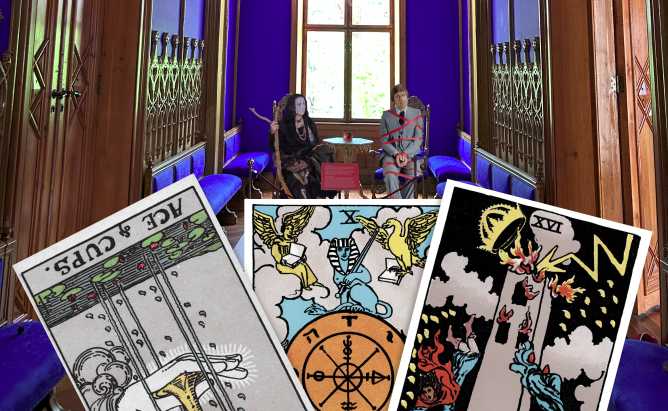
Let’s talk tarot.
4.2 Endings: Deus Ex Chartis (permalink)
For all of written history, human beings have sought out external, quasi-random inputs to direct their artistic process. We’ve all hit writers’ block before5: you think you see an ending to your story, but you know it’s just a pastiche of another story you’ve recently read, and you don’t know how to put your spin on it; the words refuse to come out.
Psychologists and neuroscientists (hello, again) have a name for this: Einstellung. When we think about a new problem that feels familiar, we resort to familiar solutions, even when we know there are simpler, creative solutions we’re not seeing (literary connoisseurship does not automatically give one greater writing instincts6).
Enter muses, man-made and artificial. To name a few – story dice (other dice are available):
https://davebirss.com/storydice
Oblique strategies:
https://en.wikipedia.org/wiki/Oblique_Strategies
I have settled for tarot cards. Back before we had large language models, there were small picture models, and they were better. Ask a question, and the cards will have an answer for you to interpret. It really is as simple as placing images, side by side, and assuming there must be a connection between them, literal or symbolic.
You do not have to be an expert in each card’s meaning – even an inaccurate reading can give you something to break the deadlock. That said, the cards work best when their designs have high visual variety. Anything and everything on a card is up for scrutiny.
It’s best if I show this by doing – I think there’s a lot more to discover about the orb-pondering wizard from my Worldbuilding workshop. I’ll pretend for a moment that this is going to be part of a longer work of fiction:
https://brologue.net/2026/03/20/worldbuilding-workshop/
...Great. Fucking GREAT. The orb's leaked!
An event thread, very common to sitcoms: the wizard needs to fix an orb that once contained a cleaning spell before his date arrives. Of course, I can’t allow the orb to be fixed until there’s enough try/fail cycles to put him through the wringer. And so, I ask the cards: What‘s the finickiest, most niggling error a wizard can encounter while trying to mend an orb? Something that’s like trying to unscrew some screws with the wrong screwdriver head (but it’s the most appropriate one you’ve got). One card will do for this, and I’ll switch to a more stream-of-consciousness style…
…I’ve pulled the reversed five of cups:
https://en.wikipedia.org/wiki/Five_of_Cups#/media/File:Cups05.jpg
The answer doesn’t always jump out at me right away. There’s a stream running underneath a bridge. If the card’s upright, is it possible to make the water run upstream? That it’s a leak suggests the magic is emulsified in some liquid. Could be viscous. If you’re trying to recover all the liquid from what’s presumably a wooden drawer, you’ll have to deal with impurities. Wood splinters and microbes could be affected by cleaning magic. That’s what the spilled cups represent: an easy, tedious mess to clear, made all the more tedious by neglecting your orbs. So, the wizard finds his staff, points it at the spill, and all the liquid runs back into the cracked orb… BUT it’s now off-colour, and slightly cloudy. Not only will the cleaning spell work with less efficacy, the temporary sentience it grants inanimate objects could have nasty side effects for living microbes. Gods know what’s been cooking in this tiny ecosystem – does the wizard really want to take a chance on creating a sentient superbug?
What went from a piece of flash fiction about finding a cleaning spell might just turn out to be a wizard making first contact with intelligent microbes. I could pull a couple more cards to represent further challenges the wizard faces, as well as how the cleaning thread resolves. I could decide I want to write a longer story, and ask the cards what MICE threads are in my wizard’s future.
In my experience, the cards have directed me to far more interesting discoveries than large language models ever will (I’ve said it before and I’ll say it again: you don’t need ’em). Characters, plot, worldbuilding descriptions – you name the writing question, find a spread you like, and then find your answers.
Be they MICE threads, or the tarot, models are positively counterintuitive, I think. You may think it’s rote, you worry that the result will be fated to cliché, but by temporarily binding our imagination with a set of rules, we make it easier to find new, creative solutions to conflicts where we might otherwise be bogged down in rote thinking.
Short endnote: I wanted to include a short story I wrote in this post, interleaved with each heading. I’ve decided to leave that for its own post. That’s something that might work for a YouTube video or podcast, but for written prose, it feels like I’m losing a thread. Expect it in a future post…
- This is one of the narrative techniques Le Guin mentions in Steering the Craft. She argues that jolting the reader out of one POV can be done, but it is hard to get right. ↩︎
- For full context, he is analysing Greek tragedies, not 300 page novels – those would come some 2000-odd years after his death:
https://www.gutenberg.org/files/1974/1974-h/1974-h.htm#link2H_4_0020 ↩︎ - And even then, on a first read, you might not realise he’s the protagonist until the second chapter opens at the beginning of his life. ↩︎
- Unless your name is Charles Dickens, and your readers need to be reminded that Jacob Marley is dead… ↩︎
- I told my MLitt cohort, quite confidently, that I don’t experience writers’ block. And then I discovered the tools you’re going to read about in the following paragraphs. So that was a fucking lie. To myself. ↩︎
- But it is better training in the craft than doing no reading at all:
https://countercraft.substack.com/p/what-not-reading-does-to-your-writing ↩︎
TTLY… (permalink)
- [07 Apr] Explaining Fantasy to Mums https://brologue.net/2025/04/07/hard-of-fantasy/

