
Twenty beautiful minutes on:
- 1. Telling Details and Incluing: or, “Pulverising the Boulder of Exposition;”
- 2. Pellargonia: A cautionary tale of worldbuilding getting out of hand;
- 3. Knowing Your Noinos: When vegetables aren’t vegetables;
- 4. Where’s My Thirty Magic Systems, bm?: If everyone knows a spell for fire…
- TTLY: Old posts.
I’m going to start this post with a writing exercise that I sprung upon the students of my fantasy writing workshop (and to whom “you” will refer to from here on):
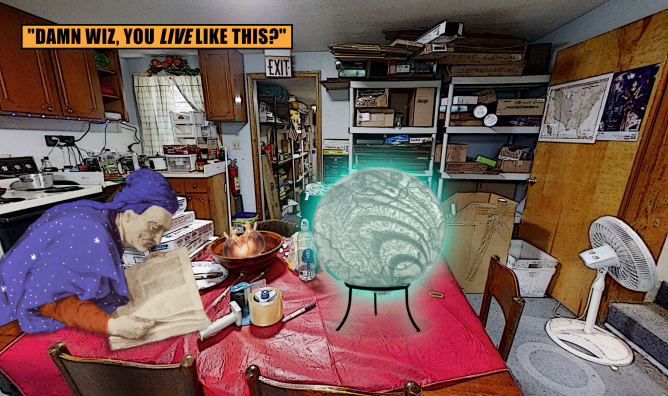
EXERCISE (20 mins): You’re a wizard. That cool and powerful enby you’ve been seeing for a while is coming round for a date in the evening. Your place is a right state (you prefer to call it an “organised mess”). In one of these rooms, you’re certain, is an object that contains the method and ingredients for an old cleaning spell from Wizarding 101.
So: where is this room? What’s the state of the mess, on a scale of “occult clutter” to “damn, wiz, you live like this?” Describe to me, in detail, the container where the spell is kept – be it a cabinet of curiosity, or a humble Tupperware box, warped from thaumic stress. Is there anything special or magical about the container that makes it more than what it seems? What other secondary and tertiary details will you use to help me visualise this room?
As your equal co-investigator of Knowledge, I am not allowed to skip my own exercises. Here’s what I came up with in twenty minutes:
I keep the orb in my ugly drawer. I know you shouldn't, but it's damn near the safest place in the house for it. A spell like that gets out, and if I'm not careful, it's Beauty and the Beast minus the soul in here - books and brooms and little tea sets cutting about, almost as if they own the place.
I can see it, across the room, but walking across the kitchen floor is a trial and a half. I daren't step on the glowing rune stones strewn across the floor. Good thinking, me, buying a stone circle off of Magebay, and forgetting that rune stones turn spicy when you don't re-enchant them. They're like lithium ion batteries, only worse, 'cos at least a battery fire would burn my house down. So they've become part of the furniture. Or floor.
They spark as I pussyfoot round them, greasy little streaks of purple lightning. I have a date to impress, and I think the sparks surely know that love is the greatest unstoppable force known to man and beast. The ugly drawer has been reached...
...Great. Fucking GREAT. The orb's leaked! I mean, I can unleak it, it's not like toothpaste coming out a tube, but it's just a pain in the arse. Plus, the concentrated ichor inside makes the hands all chalky and its--eurgh.
Tarot cards are buggered, too. Guess I won't be using Vaggard's Charmer tonight. Fine. I don't need my wizardly charms to be propped up by arcane ritual and little demons in my ear and whatnot. (They do help with the cleaning).
…Why did we torture ourselves with this? Well, firstly, writing against the clock forces you to write in creative mode only. Writers are always tempted to fritter their time with small edits, labouring over word choice, grammar, etc.. The one thing that reading fiction won’t teach you is that first drafts are messy. It is OK that they are messy. As long as you’ve made your point, the words don’t matter much – there will always be time in the future for an editing. But if you want your manuscript to reach a point where it can be edited, you have to keep your brain in that creative mode, and get the words out.
Second, and far more important to our topic, what we’ve done here is committed to an act of worldbuilding. It might not feel like it, at a glance, but when we decide what is in our wizard’s mess, we’re giving readers telling details for the world writ large. These are to worldbuilding what clues are to the crime writer.
I haven’t scaled many mountains. I’ve cut through a couple of zigzagging glens, in a car, but nary a rolling moor nor pasture green. But I have been in many homes, and so have you. If we must start our worldbuilding somewhere, there are worse places to go1.
The worldbuilding is coming from inside the house.
1. Telling Details and Incluing (permalink)
FACT: No place in fiction can exist independent of an observer. You just can’t make ’em like that. There’s always this mass of connective tissue called ‘the narrator,’ hooking us into the sights, sounds, and smells of a place. No matter how direct, how matter-of-fact, and unbiased the narrator’s description of a scene might be, there will always be someone noticing something. This applies even when someone’s describing a time before sapient observers. For instance, Rachel B. Glaser’s short story, “Pee on Water:”
https://www.vice.com/en/article/friday-tyrant-pee-on-water/
Earth is round and open, whole and beating in its early years. The stars are in a bright smear against the blackboard. A breath pulled so gradual the breath forgets. Winds run back and forth. Clouds idly shift their shapes. Stubborn ice blocks will not be niced down by the fat sun. Melted tears run, then freeze. Tiny cells slide into tiny cells. The wind learns to whistle.
It’s true that Glaser chose these telling details to telepathically beam into our brains, but until we know the Earth is round and open, the wind will not learn to whistle.
Us fantasy writers, we build worlds, and readers reconstruct those worlds in their heads, word by word. We’re not required to start at the very, very beginning of the Universe. Pratchett’s Jingo starts with:
It was a moonless night, which was good for the purposes of Solid Jackson.
He fished for Curious Squid, so called because, as well as being squid, they were curious. Which is to say, their curiosity was the curious thing about them.
Neither are we required to labour over every creature’s evolutionary history, every human discovery, every war, etc, etc. We do not need to explain a villain’s entire backstory at the constant rate of cutting toenails before treating the reader to his speech about… what was it again? World domination?
Between tell-all and tell-nothing, we need what Angela Naimou called “telling details:”
[Details] otherwise deemed insignificant but for their ability to make some bigger subject memorable.
Short Fiction, Flash Fiction, Microfiction
Depending on the project, our word budget might be economy-class. Everyone wants to be worldsmiths like Brandon Sanderson or George R. R. Martin, writing great whopping worlds of epic scale. But lest we forget, Martin started out in the 1970s selling short stories; watch any of Sanderson’s writing lectures, and you’d be wise to take note of the things he’s telling you not to do2.
Can you tell a short fantasy story without it becoming a crash course on how the world works? Say, 3000 words or less? I think you can, if you make use of a similar (but not identical) technique to telling details – “incluing:”
https://web.archive.org/web/20111119145140/http:/papersky.livejournal.com/324603.html
[T]he process of scattering information seamlessly through the text, as opposed to stopping the story to impart the information.
If you’ve read literally any sci-fi story published in recent memory, you’ve seen incluing at work. Here’s the opening paragraph to China Miéville’s Embassytown:
The children of the embassy all saw the boat land. Their teachers and shiftparents had had them painting it for days. One wall of the room had been given over to their ideas. It’s been centuries since any voidcraft vented fire, as they imagined this one doing, but it’s a tradition to represent them with such trails.
Now, if this was the opening paragraph to your manuscript, and you’re worried that readers will balk because you haven’t immediately and sufficiently explained what shiftparents and voidcrafts are… Sorry (not sorry), but you are imagining a reader who is impossible to please, who was never going to be your reader, to begin with. When it comes to sci-fi and fantasy, your audience is going to consist of people willing to pay this price of admission.
Though it’s unlikely that all of your readers will receive your telepathy 1:1, exactly as you’ve sent it, you’ve got to trust them to at least comprehend the clues you’ve given them. That’s what Miéville’s done, here: the proximity between “teachers” and “shiftparent” implies a family structure that is somewhere between teacher and parent. Again, you haven’t stopped the plot to focus on these: you’ve let your characters’ POV, and their problems, take priority, and, at the same time, put the worldbuilding on a drip feed, that the reader might whet their appetite. Not every reader will pick up what you’re putting down straight away. That’s fine – that might mean more incluing for later. This is what the workshops are for, as well: getting feedback from your peers, to better gauge where and when you need to give more info. But let them try to solve this puzzle of who shiftparents are, and show them the solution later by having a character interact with one.
Jeff Vandermeer does not call it “incluing” in his Wonderbook – instead, he makes a distinction between worldview and storyview. Ultimately, it’s the same thing: worldview is everything that you, the writer, know ahead of time; storyview is what the characters know; you build up storyview by choosing what information you’re going to share–and when. When is the difference between thin, well-defined stratigraphic layers, that leave us wanting more, and one thick wall of text that’s weary on the eyes.

So, where might our construction begin?
We are tempted, when thinking of fantasy, to let our imagination run off through rolling moors, split the foamy seas, scale frigid mountaintops, zigzag through thick, untamed woods. Heroes, we know, spend much of their time on the move, and advance the plot, likewise. The dragon’s keep is never down the street, is it?
Well, it could be. And I don’t think you need to take giant steps of longitude (or latitude… or altitude) to find magic. There’s plenty of it in your own back yard, be they city streets, or out in the sticks (where the lines between street and road are blurred, but there are neighbours aplenty who erect helpful signs for ignorant passersby: “PRIVATE PROPERTY, NO TRESPASSING”).
Remember Babel? Borges started by describing a hexagonal chamber of books, then multiplied said chamber across an infinite Universe by claiming the books held every possible ordering of text we know of.
https://libraryofbabel.info/bookmark.cgi?mce,.idphzgcbywyf,osu291
All of this, from a simple set of rules.
What I’d like to do in this workshop is to think about worldbuilding from a more domestic angle (and other adjacent angles). Social environments are potent worldbuilding catalysts. As Hannah Kaner writes:
The home is a meeting point, a cooking pot, the point of exchange, the source of our safety, and a place of discovery. The home as not a trap, not a service, but itself a source.
The Domestic and the Divine
Homes are little worlds of their own. They will contain elements of the material world – what exists that was not created by human artifice; elements of the cultural – that which was created by us; and magic – if you know where to find it (and I think you do).
With that in mind, we’re building on the Borges reading from last week with another story that focuses on what good worldbuilding does…
2. Pellargonia (permalink)
Since we focused on Borges last week, I had you read a story from Theodora Goss that has heavy Borges influences – Pellargonia: A Letter to the Journal of Imaginary Anthropology*.
Three teenagers – Julia, David, and Madison – explain to the Journal exactly how they started with the flat, ill-defined “Country X,” fleshed it out, and brought it into the real world as Pellargonia. Their research is not thrown at us, all at once, but shown session by session, like a school day. Said research is the incluing that leads us to the two mysteries set by Goss in the beginning:
- How Julia’s father disappeared;
- Why Pellargonia is about to enter a civil war.
It is not explicitly stated in the beginning that Pellargonia is in political turmoil, but there is one word, one telling detail that, as soon as you read it, you just know: “rebels.”
You might be older and wiser than these teens, and you may envy their free time that you no longer have, but they are doing what all writers of fantasy must do, and want to do (with the added bonus of seeing their creation come to life and immediately escape their control): research. It is the fickle dragon of ideas that must be slain, again and again.
And the Tlon hypothesis says that, once you create a country, it takes on a life of its own, and then it’s not yours anymore. That’s supposed to be the coolest thing about it.
Q: When have you done enough research? When have you done too much?
With research, there’s no start, no end, no yellow brick road, but there is a hell of a lot of forking paths, and though not all of them will take you to the Emerald City, you will make it there, at some point. That said, we don’t want to end up in an ideas quagmire, where you are held stuck by a menagerie of misfit ideas that don’t quite fit together yet.
The kids seem to have figured it out. Pellargonia’s history is a collage of Western European history. They’ve taken their school subjects apart like a Jenga tower, remixed names, places, people, and put ’em all back together.
I prefer history and romance… [Country X] had war for David, and lots of drama for Julia…
Your fantasy world, too, could start like this. Read about the Renaissance, the Medici family, famous battles, etc.. Take a note of all the ‘what-ifs’ you might have, even if they’re nonsense. That’ll certainly give you some scaffolding to play with.
Fact is, we fantasy writers are in the map-making business – and I’m not just talking about the ones we find before page one. It’s telling details and incluing all the way down, for they are what draw the map to our fantastical territory. For all the research you’ve done, not every juicy fact will make it to the page, nor will you always know ahead of time what needs to be cut. First drafts are messy like that.
When it comes to the amount of time we spend on researching: given that the upper limit on procrastination is “the rest of your life,” why not try researching against the clock? Set small deadlines you will honour.
Yes, I know. You will not get the chance to thoroughly research everything. You will still end up researching things when you’re writing your story, as and when they become important. I fucking hate deadlines, too. and knowing there’s stuff out there that I don’t know, that might be important, kills me. However, if you take the time to clarify what you want to research, how long you want to spend on it, and how long you want to spend writing the first draft, you will objectively have more of a first draft.
3. Knowing Your Noinos (permalink)
Back to Pellargonia, for a moment. From what Goss inclues, it seems like the kids treated their school subjects like jigsaws cut with the same die. That is, they took them apart, and remixed them, to create a chimera. Similar parts, completely new context:
https://puzzlemontage.crevado.com
Pellargonia didn’t exist until the kids added stuff, right? When you open a new Word document, it is a blank page, the very symbol of our unlimited imaginative potential:
🗋
That’s how worlds are built. Brick by brick; line by line, we draw our maps. You add words. Right?
Q: Is worldbuilding an additive or subtractive process?
I promise you, this is not a pointless semantic argument.
Creation implies adding a something to the universe where there was previously nothing. Such an idea is as old as Genesis – and older still:
In the beginning God created the heaven and the earth.
But we are not literal gods – even when we’re writing, the world we build doesn’t come from nowhere. We are more like cooks. You might prepare and add ingredients into a pot for soup – potatoes, peppers, onions, carrots, garlic, lentils, water. The soup’s flavour will be the product of those ingredients mixing together. Said ingredients, however, were subtracted from elsewhere, first: a supermarket, a field, the soil.
This being fantasy, who says we need to make soup? If you see worldbuilding as a task of addition, sure, you can take an onion, stretch it, make its skin thicker, reduce the number of layers, make it emerald green, and call it noino; that new vegetable will certainly be interesting. You might, however, struggle to think of how vegetables can be anything other than vegetables.
Subtraction, on the other hand is the stuff of Chesterton’s tremendous trifles. By first thinking about what real-world objects are not, that is how we go from pumpkins to carriages. Subtract an onion from our material world entirely, and suddenly, what it signifies is entirely up for grabs3.
Who’s to say that the “vegetable” commonly known as “onion” isn’t, in fact, the droppings of a fae creature who can’t be seen? You may mark its presence by the dropping’s odour, and your tears, but said odour and tears mask it, too. Unless you’re anosmic and you lack lacrimal glands, you’ll never see it.
So, add, or subtract? It’s a false dichotomy. As fantasy writers, we do a little bit of both.
4. Where’s My Thirty Magic Systems, bm? (permalink)
The purpose of a system is what it does.
Stafford Beer
Finally (if there’s still time4), a very brief aside on magic systems. If we can start worldbuilding from home, then we can show how someone might use magic to solve problems in their home.
One argument someone might give for why they balk at fantasy is that magic eliminates stakes. If magic has no rules, and can be used to make anything happen, you might as well call it an act of God. They may not be your readers, but it’s still a valid point.
To make good magic, I think it’s worth knowing what makes for good sci-fi.
Cory Doctorow’s definition of science fiction goes like this: it’s not just about describing what technology does, but who that technology does it to, and who it does it for. Technology is not, and has never been, apolitical. If a powerful person can leverage technology to make you do what they want, they will. They’ll pull the wool over your eyes and make you believe that it’s impossible to use technology in ways that do not favour them:
https://pluralistic.net/2025/12/05/pop-that-bubble/
Mark Zuckerberg wants you to think that it’s technologically impossible to have a conversation with a friend without him listening in.
Whether your magic is “hard” or “soft,” whether it has rules clearly defined, we want to see it at work – not just what the magic does, but who magic does it to, and who magic does it for. This is why eighty percent of a magic system is shown through problem-solving. The other twenty percent is told. Inclue how the spell works as the character’s solving the problem, let the reader guess, and give them the solution later. Showing how your magic works early on gives you an opportunity to misdirect your reader later – as in, they expect a problem to be solved with magic one way, but you either show them a different, unexpected solution, or the previous solution backfiring.
Some of the oldest magic systems we have are so old, they were neither magic nor system – they were the stuff of myth and folklore. Mind the Pratchett quote about fantasy being the ur-literature: those ancestors of ours sitting around the fire, thousands of years ago were just as concerned, albeit for different reasons, about the effects of magic as we are today. Obviously, they didn’t distinguish it like we do. It was how their world worked: if you want to keep the local fire god fed, you’ve got to slaughter some chickens on the ziggurat from time to time, and let him feast on the smoke. Facts.
A bit later than that, and civilisations like Ancient Greece were recording recipes for magic. Want to prevent fever? Cut out a viper’s heart while it’s still alive, and wrap it in linen. Liver acting up? There’s a plant that looks like a liver. That’ll do the trick:
https://en.wikipedia.org/wiki/Marchantia
James Frazer, a Victorian-era anthropologist, identified this as the “law of sympathy.” Likenesses link up, whether that be rocks and their true names, or a victim and their voodoo doll. Bitten by a stray dog? Take some of its hairs and place them in the wound.
Another law that’s older than Genesis: magic always has a price that must be paid. A genie will give you what you want, but you won’t want what you get; perhaps a teleportation spell only works by switching places with objects of similar mass. An elaborate summoning spell requires setup time, a lot of chalk, and, most importantly, other people.
And the purpose of a system is what it does. If everyone knows a spell to light a fire, everyone knows a spell for arson. You might restrict magic to a select few – perhaps it’s an academic study, or a genetic mutation – should you decide that that is a part of your world, then I hope your story has an answer for why magic-user supremacy is not a problem.
If a spell can clean your kitchen, do you know how fast all the objects are going to move? Can that even be controlled? Can you perform the spell while you’re not in the kitchen yourself? (I know a wizard who knew a wizard who tried to plow his drive with that spell. The snow was so tightly packed, and it didn’t know where else to go…)
The purpose of a system is what it does. You, as the magic system designer, may struggle to find exceptions on your own. Good thing that we’ve got our peers to raise exceptions for us.
That’s enough, for now. They say there’s nothing new under the sun; hell, there’s nothing new over the sun, these days. Yet we’re no less fatigued by this fact than we were a century, a millennium, ten thousand years ago. Still are we compelled to subtract objects from the material world, stick ’em in our petri dishes, like oats, and then set the Slime Mould of Story on ’em.
Next stop: characterisation!
- Such as A Long, Long Time Ago; In the First Age; and the Big Empty. ↩︎
- There aren’t any hard “don’t”s in writing fiction. Only things that are merely hard to do right. ↩︎
- You’ve also subtracted whenever you’ve mistaken one thing for another. Like when the cat you’re speaking to from across the room turns out to be a shirt in a heap ↩︎
- (In the actual workshop, we did not, in fact, have the time. I’ll have to work this into a future workshop, somehow…) ↩︎
TTLY… (permalink)
- [Feb 28] The Light King’s Tale: The Right to Krei https://brologue.net/2025/02/28/the-right-to-krei/
- [Mar 06] Mnemonics, Divination, and the Return of the Secret Strings https://brologue.net/2025/03/06/secret-strings-revenge/
